E-commerce in the fourth quarter of 2010 for the first time clearly represented more than 20% of all deliverable retail sales. E-commerce's share of retail sales grew by a third in less than 5 years.
The following graph illustrates the change in share of seasonally adjusted retail sales.
The 20% figure represents the proportion of catalog and on-line sales estimated by the Census Bureau as a portion of sales at furniture & home furnishings (442), electronics & appliances (443), clothing & accessories (448), sporting goods, hobby, book, and music (451), general merchandise (452), office supply, stationery, and gift stores (4532) stores as well as on-line and catalog merchants (4541). [The numbers in parentheses are the NAICS codes used by the Census Bureau to classify businesses.] As many retailers, (i.e., Walmart, JCPenney, Target, Best Buy, Limited Brands (Victoria's Secret, Bath and Body Works) and Best Buy) that currently generate most of their sales from brick and mortar outlets now generate a growing proportion of their total sales from their websites, this proportion represents a conservative estimate of the share of deliverable retail sales that FedEx, United Parcel Service or the United States Postal Service are delivering.
The chart above also illustrates, that for most of the period since 1992, delivered retail sales grew as a share of deliverable retail sales has grown by around 50% about every 7 years ( i.e. 6.67% to 10%, 10% to 15%). Since 2005 the rate of growth in delivered market share has quickened and the fifty percent growth rate to a 22.5% market share should come sometime near the end of next year.
The shift of retail from brick-and-mortar to catalog and e-commerce sales will have a profound impact on the retail supply chain, local economies and demand for print communications.
The retail supply chain over the next decade will have little choice but focus on home delivery. Lower-cost deliveries by parcel carriers and other firms to retail outlets will decline while higher-cost deliveries to homes will increase. The need for pick-up locations for high value items will grow which will increase the market for delivery lockers like those used by Deutsche Post, Post Danmark and DHL.
The growth of e-commerce sales will also increase both shorter-haul deliveries from warehouses within carrier one-day, and to a lesser extent two-day delivery windows. The growth of short haul traffic will also allow regional carriers to continue to grow their market share in more densely populated regional markets.
Finally e-commerce sales provide opportunities for integrated carriers like FedEx and UPS. These carriers can manage home deliveryof high-demand, and high-value items that companies like Apple Computer ship direct from warehouses near the manufacturers in China and other countries in the Pacific Rim.
The impact of delivered retail sales on many local economics is significantly negative. Many communities have a retail infrastructure that reflects a world where less than ten percent of all sales were delivered. Shopping malls and strip centers with vacant store fronts will find it more difficult to rent vacant space and will look to non-traditional and more than likely lower paying tenants like government agencies, libraries, medical and dental offices, and service providers like nail salons. Fewer retail stores mean not just fewer retail jobs but also fewer jobs required to build and maintain retail outlets. Lower brick-and-mortar retail sales will have the effect of lowering gasoline consumption as trips to the store are replaced by trips to the computer. To the extent that restaurant and fast food sales are tied to retail shopping, those sales will slip as well.
The shift of retail sales will have some positive impact on communities located near ideal distribution points that can take advantage of one-day delivery standards of ground parcel delivery. These communities should see growth in jobs in warehousing and transportation and may see some growth in other industries that will piggy-back on strengthened transportation infrastructure that e-commerce distribution supports.
Finally, the shift to on-line sales could have a devastating impact on print advertising, and in particular newspaper display ads and direct mail from local merchants. To the extent that on-line sales cause brick and mortar retailers to go bankrupt, the trend removes print advertisers from the marketplace. Remaining retailers may not be willing to pay as much for advertising as the firms they replace. Adding to the challenge facing print advertising is that the largest on-line retailer, Amazon.com, spends minimally on print advertising and its smaller on-line competitors are no different. Printers and the Postal Service need to find a way to create products that fit the needs of on-line retailers who have found that they could grow their business successfully with minimal print advertising if advertising mail and other forms of print advertising can continue to grow.
Showing posts with label UPS. Show all posts
Sunday, April 24, 2011
Wednesday, November 3, 2010
Hits and Misses in Parcel Pricing
Most analyses of the Postal Service's proposed parcel rates and service initiatives will come from the shipper perspective. However, given the Postal Service's financial condition, they need to be viewed from the same perspective that investment analysts look at pricing decisions of FedEx and United Parcel Service. From this perspective, the changes look like a mix of hits and misses.
Hits
Hits
- Expansion of the number of flat rate boxes and envelopes is a hit for consumers and small businesses - It allows the Postal Service to sell pre-posted boxes at nearly any retailer in a manner similar to its arrangement with Office Depot.
- Expansion of Hold for Pick-up Service - This should be a big hit with one major caveat. Items that are either bulky (i.e. comforters, pillows, fragile items), large (i.e. High Definition televisions and microwave ovens), or valuable now have a USPS delivery option. This should be most valuable for shipments to rural areas. The caveat is the number of hours that Post Offices are open. For this service to be truly effective, Post Offices need evening hours.
- Increases in rates to DDU for light weight parcels - The volumes that FedEx SmartPost, UPS Mail Innovations and other consolidators are generating are sufficient to justify raising rates significantly on the lightest weight shipments that they now tender to the Postal Service. These weight cells must be as profitable as all others.
- Timing of announcement - The Postal Service should have waited at least another week to allow its rate increase to come after both United Parcel Service and FedEx. Given its market share, the timing of its announcement should reflect its position as a price follower.
- Uniform national drop shipment rates - The Postal Service is creating significant opportunities for cream skimming by charging the same drop-shipment rates to DDU's and SCF's regardless of where they are in the United States. The market for last mile service is very different in Montgomery County, Maryland (DC Suburbs) and Garrett County, Maryland (far western Maryland). The cost of serving these two markets is different as well. By charging the same rate for both locations, the Postal Service is under-pricing the service to Garrett County encouraging carriers to drop-ship items that may not be profitable for the Postal Service to handle. The opposite is true in Montgomery County Maryland. With differential prices the Postal Service could increase the fuel allowance for rural carriers that will be delivering the parcels in rural areas that UPS and FedEx do not want to deliver. (Royal Mail's destination entry pricing are geographically based and it has worked well for both Royal Mail and mailers.)
- Average rate increase - The Postal Service's average rate increase of 3.5 percent for Priority Mail and all 3.6 percent for all Shipping Services is below the rate increases that UPS and FedEx have announced and most likely below the rate increases that they will be able to get from their commercial customers. In particular, retail Priority Mail rates should rise at the same rate FedEx Ground and UPS for Zones 1-3 and 2nd day air for longer distance zones. Commercial Priority Mail rates should increase a bit less to reflect the competitive of commercial markets.
- Impact of pricing on positioning Shipping Services in the marketplace. The Postal Service's pricing moves should significantly differentiate USPS prices from that of its competitors. The lower prices fit the perception in the commercial marketplace that the USPS offers a lower cost, lower quality service. The Postal Service is forced to be the low-cost, low-quality provider until its transit times for Priority Mail meet those of FedEx Ground and UPS for shorter distance shipments.
- The impact of flat SCF drop-shipment rates on the use of the Postal Service for last mile delivery. The Postal Service faces a risk that its last mile delivery service will be less profitable than it should be given the lack of geographic-specific drop-off rates.
- Whether the Postal Service's cautious view of the pricing power of parcel carrier's is correct. Both FedEx and United Parcel Service are beginning to see that its price increases are sticking in contracts that they are signing this fall. The Postal Service's approach requires an economic forecast that is less robust than what United Parcel Service and FedEx now project.
- Missed Flat-rate opportunities. While the Postal Service introduced a new padded envelope, it could have also created multiple sizes for padded or even un-padded envelopes. The larger envelopes would serve the needs of shippers of clothing that now ship in large envelopes that can hold two to four pairs of jeans. Why not have a flat rate product for every size padded envelope that is generally sold in the local office supply store.
Friday, September 17, 2010
FedEx Earnings - Implications for the USPS
FedEx's earnings announcement and conference provided some insights into the parcel market and the increasing integration of the Postal Services delivery network with the marketing and distribution capabilities of FedEx. The comments relating to FedEx Smart Post seem to indicate that United Parcel Service and other carriers that compete in the market for delivering small parcels to households, whether by their own drivers or by the Postal Service may be losing market share to FedEx.
Here are the relevant excerpts:
Parcel Volume
Dave Bronczek – President and CEO of FedEx Express from the Q & A
The Postal Service can expect an increase in parcels in the 4th quarter and beyond at least as much as large as what FedEx expects. As will be shown below, the volume of parcels that the Postal Service delivers is tied to how many parcels FedEx and other similar firms feed to its delivery network.
Distribution Patterns
Alan Graf - CFO from the Q and A
In response to a question about inventory, Alan Graf highlights one of the challenges competing in the domestic home-delivery parcel market. Inventory of items manufactured overseas, and in particular items that weigh less than ten pounds are no longer shipped to a domestic warehouse for shipping to the household customers. As the retailer does not know where in the United States the sales will come from or for that matter, what color, size, and in the case of computers, the processor, specific amount of memory, size of hard drive, and other components that the customer plans to order, keeping inventory in the United States becomes quite expensive. Given the difference in labor costs, it becomes cheaper to pay international air freight than to ship a basic model to the United States, and then modify it for individual orders.
FedEx continues to deliver these items within its Express network and United Parcel Service delivers them within their standard network. The Postal Service could enter the market for the delivery of foreign sourced retail sales for home delivery only if it offered a price competitive delivery service in conjunction with DHL or TNT or a foreign post that offered the same security as what FedEx and UPS offer (signature requirements and tracking service) at a competitive price for the total end to end transportation charge. It could more easily offer a price competitive service that allowed for pick-up at a Post Office or automated kiosk in conjunction with any carrier for a price well below the cost of home delivery.
Parcel Prices:
Mike Glen - President and CEO of FedEx Services from the Q & A
We were pleased with the Domestic Express volume performance. It is also being driven by the high-tech high value added sector. But the particular point that I want to make here is about the strong yield management activities that are in place and we will continue going forward. That is our primary objective. While we want to continue to grow volume and expect that we will do that, our primary focus is on improving yields, at the domestic Express business as well as in Ground and certainly LTL. So, our primary focus is not on market share so much as opposed to continuing to improve yields.
Dave Bronczek – President and CEO of FedEx Express from the Q & A
FeEx's increases in yield (average revenue per piece) reflect a concerted effort to raise the average rate that its customers pay. While some of the increase in reflects an increase in weight and a higher proportion of international shipments for FedEx Express, it is clear that even in an economy with slow growth, FedEx is able to raise its prices for parcel delivery services.
Service Quality:
Fred Smith from opening statement
For the Postal Service, FedEx Ground's improved service standards pose a competitive threat to Priority Mail as for many origin destination pairs FedEx Ground rates are less than Priority Mail. To the extent that United Parcel Service is also expanding the geographic area that has delivery in less than two or three days, they create a competitive advantage over Priority Mail.
Integration with the Postal Service Delivery Network:
Mike Glenn - President and CEO of FedEx Services
Fred Smith from the Q & A
Alan Graf - CFO from the opening statement
FedEx clearly sees its SmartPost service as a competitive advantage. Given that it offers shippers in a highly price sensitive market very low parcel delivery rates a competitive service it increases what the Postal Service delivers. Pricing this service to FedEx requires a great deal of understanding as to what FedEx is charging customers and what portion of that charge represents the Postal Service's part. Trying to set this rate within a regulatory context is particularly difficult and raises a question as to whether the rate increases for the Postal Service's portion of the revenue from a parcel delivery shipment should reflect the ability of FedEx and similar carriers to raise prices for end to end service or some other standard.
To the extent that regulated parcel services are primarily originated by FedEx and similar firms, then the value of the regulation to the shipper of regulated rates may be diminished by the benefits that FedEx and similar firms capture for themselves.
Here are the relevant excerpts:
Parcel Volume
Dave Bronczek – President and CEO of FedEx Express from the Q & A
Well, Art, as Fred mentioned in his opening remarks, we expect a very solid peak season. It always gets a little cloudy after that with the key focal point being Chinese New Year. So, we're optimistic about going into the holiday period and I think we'll have strong performance both in our U.S. networks and international networks through the peak season, but it always gets a little cloudy after that with the important period being around Chinese New Year.
We do expect solid industrial production numbers for the calendar year 2010 and going into 2011 in the 4% to 5% range, and we expect a little bit of consumer spending pickup. Our numbers are around 1.5 in calendar year '10 and about 2.6 in calendar year '11. So those are numbers that we’re very comfortable with in terms of supporting our business levels. Obviously, we'll need to wait a little while after peak season to see what the remainder of the year looks like.
The Postal Service can expect an increase in parcels in the 4th quarter and beyond at least as much as large as what FedEx expects. As will be shown below, the volume of parcels that the Postal Service delivers is tied to how many parcels FedEx and other similar firms feed to its delivery network.
Distribution Patterns
Alan Graf - CFO from the Q and A
Let me just add, particularly in the high-tech sector, our customers don't have any inventory. And what's happening, the market is coming to us as there's a disintermediation of intermediate distribution. Items are going directly from where they are manufactured to point of consumption, which is called International Priority Express, and that's what’s so exciting about the next few years around here is, that's going to continue, and with the reliability that we put up, there's no need to have an intermediate warehouse and there's no need to have a backlog of things that can go obsolete on the shelves and that's part of the excitement that we see around here.
In response to a question about inventory, Alan Graf highlights one of the challenges competing in the domestic home-delivery parcel market. Inventory of items manufactured overseas, and in particular items that weigh less than ten pounds are no longer shipped to a domestic warehouse for shipping to the household customers. As the retailer does not know where in the United States the sales will come from or for that matter, what color, size, and in the case of computers, the processor, specific amount of memory, size of hard drive, and other components that the customer plans to order, keeping inventory in the United States becomes quite expensive. Given the difference in labor costs, it becomes cheaper to pay international air freight than to ship a basic model to the United States, and then modify it for individual orders.
FedEx continues to deliver these items within its Express network and United Parcel Service delivers them within their standard network. The Postal Service could enter the market for the delivery of foreign sourced retail sales for home delivery only if it offered a price competitive delivery service in conjunction with DHL or TNT or a foreign post that offered the same security as what FedEx and UPS offer (signature requirements and tracking service) at a competitive price for the total end to end transportation charge. It could more easily offer a price competitive service that allowed for pick-up at a Post Office or automated kiosk in conjunction with any carrier for a price well below the cost of home delivery.
Parcel Prices:
Mike Glen - President and CEO of FedEx Services from the Q & A
We were pleased with the Domestic Express volume performance. It is also being driven by the high-tech high value added sector. But the particular point that I want to make here is about the strong yield management activities that are in place and we will continue going forward. That is our primary objective. While we want to continue to grow volume and expect that we will do that, our primary focus is on improving yields, at the domestic Express business as well as in Ground and certainly LTL. So, our primary focus is not on market share so much as opposed to continuing to improve yields.
Dave Bronczek – President and CEO of FedEx Express from the Q & A
This is Dave. I’ll just add to what Mike said, and I've mentioned this a couple of times before and we'll talk about it in a couple of weeks here. Yes, the volume is up 3% and yes, my yields are up 7% for an overall revenue increase of 10%, but again, the global network that FedEx Express is, the more international packages that end up in the United States in the inbound, or outbound part of my cycle drives more and more profits automatically. So, the more international packages that end up in my U.S. domestic trucks coupled with the yield improvement program that Mike just talked about is a significant profit driver for FedEx Express.
FeEx's increases in yield (average revenue per piece) reflect a concerted effort to raise the average rate that its customers pay. While some of the increase in reflects an increase in weight and a higher proportion of international shipments for FedEx Express, it is clear that even in an economy with slow growth, FedEx is able to raise its prices for parcel delivery services.
Service Quality:
Fred Smith from opening statement
FedEx Ground continues to accelerate its network providing a clear speed advantage over the competition. Quite simply, FedEx Ground is faster to more U.S. locations than any other ground carrier.
Just since this last January, FedEx Ground has increased the speed of nearly 3,700 lanes. Since June 2003, FedEx Ground has accelerated its delivery times by one day or more in about 82,000 lanes. FedEx Ground now delivers more than half its volume of packages in two business days or less, and more than 80% in three days or less. FedEx Ground service levels are at all-time highs.
For the Postal Service, FedEx Ground's improved service standards pose a competitive threat to Priority Mail as for many origin destination pairs FedEx Ground rates are less than Priority Mail. To the extent that United Parcel Service is also expanding the geographic area that has delivery in less than two or three days, they create a competitive advantage over Priority Mail.
Integration with the Postal Service Delivery Network:
Mike Glenn - President and CEO of FedEx Services
I want to comment on one thing and caution you about looking at the Ground numbers in a vacuum. One of the strategic advantages that we have is SmartPost. SmartPost allows us to attack the residential lightweight business in a very efficient and profitable way. So rather than trying to steer that traffic into the Ground network and the Home network in particular, we steer that traffic into the SmartPost network.
So by definition, some of the growth potential that might otherwise go to Ground is going to SmartPost, and I think you can see the very strong performance we have there. So you have to look at our Ground strategy as an overall residential strategy, including SmartPost. We are very pleased with our ability to continue to have industry-leading growth rates and very strong yield improvement efforts at Ground, and I think that's based upon the combination of a great sales team that is armed with the tremendous value proposition and that's a formula for success.
Fred Smith from the Q & A
So, a good example of that is what Mike Glenn just talked to you about. If you really want to talk about the most cost-sensitive segment of the market, it is lightweight, low value-added retail items going to the home. There is no one that has the density that can compete with United States Postal Service. That's why several years ago, we came up with the strategy of developing a SmartPost service, and why it is growing at huge rates. So, we firmly believe that our strategy which has allowed us to pick-up in the commercial ground sector, what about 12 market share points...
Alan Graf - CFO from the opening statement
FedEx SmartPost average daily volumes grew 9% to $1.1 million as a result of gains in market share and the introduction of new service offerings. Yields at FedEx SmartPost increased 19% primarily due to lower postage costs as a result of increased deliveries to U.S. Postal Service, final destination facilities and higher fuel surcharges.
FedEx clearly sees its SmartPost service as a competitive advantage. Given that it offers shippers in a highly price sensitive market very low parcel delivery rates a competitive service it increases what the Postal Service delivers. Pricing this service to FedEx requires a great deal of understanding as to what FedEx is charging customers and what portion of that charge represents the Postal Service's part. Trying to set this rate within a regulatory context is particularly difficult and raises a question as to whether the rate increases for the Postal Service's portion of the revenue from a parcel delivery shipment should reflect the ability of FedEx and similar carriers to raise prices for end to end service or some other standard.
To the extent that regulated parcel services are primarily originated by FedEx and similar firms, then the value of the regulation to the shipper of regulated rates may be diminished by the benefits that FedEx and similar firms capture for themselves.
Friday, July 2, 2010
Could the Postal Service Lose its Niche in Parcel Delivery?
The Postal Service's parcel delivery business have a limited competitive advantage in serving customers that send three types of shipments.
Unfortunately for the Postal Service these advantages are tenuous. Postal Service competitors are now exploring secure alternative delivery options for households that reduce delivery costs per package by eliminating delivery to the home itself and more importantly eliminating multiple delivery attempts when no one is home when the first attempt is made. These carriers are exploring the marketing campaign needed to implement the parcel pick-up and delivery systems sold by KEBA and now installed by Austrian Post, DHL Deutsche Post, Post Danmark, Posten Norge, and PTT Turkey.
If such a system is installed in the United States, the Carrier could provide the recipient with the location of the secure parcel box and the code for retrieving their parcel as part of the track and trace record. Such boxes could be placed outside of existing retail outlets like FedEx Office, Staples, UPS Stores or other contracted location offering 24-hour access to delivered parcels. Without the need for employees to staff a parcel location, private sector carriers could offer full service parcel and express services in communities that are currently too small for even franchise or contract locations. Such a system would also allow private sector carriers to offer six and even seven day delivery without requiring it to go to every address that receives a parcel. This would be a major advantage if the Postal Service eliminates its Saturday delivery service.
This blog discussed how such a system could expand the retail presence of the Postal Service last August through the use of such automated parcel systems. in two posts.
Should the Postal Service Close All Post Offices?
Marketing the Pakstation
If competitors chose to do this first, then the Postal Service risks the loss of a significant share of its parcel delivery business that exist because competitors chose it as the delivery contractor. The Postal Service could further lose business from retail customers who find that the automated solutions of competitors are more convenient.
- Items under 2 or 3 pounds shipped to households. These customers either ship these items themselves or use a consolidator like FedEx Smart Post.
- Items shipped to rural areas and in particular rural households.
- Infrequent shippers who find retail services offered by the Postal Service more convenient or lower in cost.
Unfortunately for the Postal Service these advantages are tenuous. Postal Service competitors are now exploring secure alternative delivery options for households that reduce delivery costs per package by eliminating delivery to the home itself and more importantly eliminating multiple delivery attempts when no one is home when the first attempt is made. These carriers are exploring the marketing campaign needed to implement the parcel pick-up and delivery systems sold by KEBA and now installed by Austrian Post, DHL Deutsche Post, Post Danmark, Posten Norge, and PTT Turkey.
If such a system is installed in the United States, the Carrier could provide the recipient with the location of the secure parcel box and the code for retrieving their parcel as part of the track and trace record. Such boxes could be placed outside of existing retail outlets like FedEx Office, Staples, UPS Stores or other contracted location offering 24-hour access to delivered parcels. Without the need for employees to staff a parcel location, private sector carriers could offer full service parcel and express services in communities that are currently too small for even franchise or contract locations. Such a system would also allow private sector carriers to offer six and even seven day delivery without requiring it to go to every address that receives a parcel. This would be a major advantage if the Postal Service eliminates its Saturday delivery service.
This blog discussed how such a system could expand the retail presence of the Postal Service last August through the use of such automated parcel systems. in two posts.
Should the Postal Service Close All Post Offices?
Marketing the Pakstation
If competitors chose to do this first, then the Postal Service risks the loss of a significant share of its parcel delivery business that exist because competitors chose it as the delivery contractor. The Postal Service could further lose business from retail customers who find that the automated solutions of competitors are more convenient.
Labels:
FedEX,
KEBA,
pakstation,
Postal Service,
UPS
Friday, April 30, 2010
Smart Post - What Does its Success Suggest for Letter and Flat Mailers
In my previous post, I noted that FedEx volumes for Smart Post exceeded the Postal Service's measured volumes for Parcel Select. This implied that FedEx Ground, UPS and other parcel consolidators used other postal products, most likely Standard Mail Parcels, to handle the parcels that they want delivered less than 1 pound. The attention that Smart Post received from analysts raised some additional questions that suggest that there may be Postal Service revival strategies that are not the focus of the current discussions about future business models for the Postal Service.
So lets start with what we know about Smart Post and how the Postal Service handles it.
What We Know
Instead the Postal Service is moving forward with actions that affect its core customers (mail that contains advertising, including advertising in magazines and accompanying bills and statements) the most: eliminating service on Saturdays and raising prices. The impact of this strategy is clear.
So lets start with what we know about Smart Post and how the Postal Service handles it.
What We Know
- The volume of parcels that FedEx Ground and United Parcel Service employ the Postal Service to delivery are growing faster than the United States parcel market is growing.
- The volume of parcels that the Postal Service is handling for all customers is not growing as fast as the overall market.
- The Postal Service's volumes for its products that that FedEx Ground and UPS use is declining while their volume using these products are increasing. This trend means that the Postal Service is becoming increasingly reliant on FedEx Ground and United Parcel Service to market its delivery services to shippers.
- The growth in the use of the Postal Service by FedEx Ground is attributed to the improvements in delivery service quality that came when the National Distribution Center network restructuring was implemented.
- The growth in the use of the Postal Service also came at a time that the Postal Service held rates for parcels under 1 pound constant (due to the rate cap) making the Postal Service's delivery service more competitive with FedEx Ground or United Parcel Service using their own resources to deliver light weight parcels. It is unlikely that costs that FedEx Ground or UPS would have incurred using their own resources remained constant during this period.
- The network distribution center realignment has reduced the cost of handling bulk parcels. See USPS-OIG (Management Advisory Report – Network Distribution Center Phase 1Activation (Report Number EN-MA-10-001)
- The cost savings from the network distribution realignment would have been larger if management had taken actions to reduce excess employees months earlier than they had. (See (Management Advisory Report – Network Distribution Center Phase 1Activation (Report Number EN-MA-10-001. p 12)
- A serious network realignment effort both cuts costs and improves service.
- Improvements in service and competitive prices increase use of the Postal Service's delivery service.
- The Postal Service could improve its competitive position in the delivery of printed advertising if it implemented a network realignment for its letter and flat mail streams that at least as aggressive as it just did for parcels.
- It may be time to rethink the current classification of some parcel services as market dominant products as most users of these products are buying delivery services from the Postal Service in a highly competitive market for the provision of services to deliver small parcels.
- Cost savings from network realignments require that plans to excess employees need to begin before it is known how many employees may be released. The USPS-OIG report indicates that it takes between 4 and 11 months to complete the Article 12 provisions in its labor contracts. So unless it begins the excessing process before a consolidation is approved, it will have excess employees in standby rooms for months waiting for the negotiated process to be completed.
- Currently network realignment including excessing unneeded employees takes as long as 18 months from the time a proposal is announced until all excess employees are reassigned.
- Current facilities may not be the right size or in the right location to optimally restructure the network. For example, consolidating carrier route sequencing in processing plants would reduce operating costs and increase the proportion of mail that the Postal Service handles that is route sequenced, as this consolidation reduces mailer transportation costs to the location where the sequencing occurs.
- Capital does not exist to cover the costs of relocating or expanding facilities to meet the needs of a more streamlined network.
- Capital does not exist to cover the severance or early retirement incentive costs required to handle excess employees.
- Political considerations make it difficult to consolidate facilities and just as importantly increase the time required to complete public hearings prior to announcing that a consolidation proposal will proceed. The effort required to prepare and hold public hearings add to the cost burden.
Instead the Postal Service is moving forward with actions that affect its core customers (mail that contains advertising, including advertising in magazines and accompanying bills and statements) the most: eliminating service on Saturdays and raising prices. The impact of this strategy is clear.
- Valassis is expanding its use of alternative delivery networks in nearly every market where such services exist.
- Firms that provide alternative delivery in portions of markets are expanding the geographic reach to cover more households. For example, Donnelley Distribution has just added Delaware County Pennsylvania to its coverage area and Power Direct is expanding into the Las Vegas market. Both of these companies provide services that effectively compete on a price and service basis with the rates the Postal Service charges for saturation flats.
- The Economist is experimenting with home delivery using delivery services that provide newspaper or periodical delivery for other customers. If the Economist's subscribers like the new method of delivery, it is likely that the Economist will continue to use alternative delivery.
- Major media companies, in addition to expanding their use of alternative delivery for periodicals and saturation advertising, are discussing nationwide distribution deals with hand delivery companies to move items currently handled as First Class mail to alternative delivery using a combination of drop-shipping and same day delivery, a service that the Postal Service does not offer, to avoid violating the private express statutes.
Tuesday, April 13, 2010
Postal Policy: Now its Congress's Turn
Now that the Government Accountability Office report is out it is time for Congress to get down to the serious business of re-evaluating the current business model and regulatory framework. Congress is starting this process with hearings in the House and Senate, this week and next. In preparing for these hearing, members on the relevant committees have a significant challenge preparing for the postal and other governmental witnesses.
Both hearings will focus on reports by the Postal Service, Government Accountability Office and the USPS Office of Inspector General.
The three reports by the USPS Office of Inspector General cover technical actuarial and accounting issues over which there is a dispute between the Postal Service and the Office of Personnel Management as well as a critique of Congressional budgetary actions relating to the Postal Service. The CRS, GAO and the Postal Service have recognized the importance of the resolving the CSRS accounting and retiree health care funding issues in their reports. The critique of Congressional budgetary actions provides some context as to how Congress and the Office of Management and Budget has historically viewed their responsibility for the Postal Service and how the Postal Service’s cycles of strong and weak financial performance can be used as part of the solution of meeting budget goals.
The Postal Service’s report provides an action plan for operating its business within the current business enterprise business model. The modifications requested are changes from current financial, operating, employment, and marketing efforts that Postal Service management and the Board of Governors are sufficient to return the Postal Service to financial stability.The Postal Service’s report does not address the overarching mail industry policy, corporate governance and regulatory framework issues in any detail. Nor does the Postal Service report provide a vision for the Postal Service’s role in the US economy in 2020 that is much different than what now exists with the exception that its impact will be much smaller.
The GAO’s report, like the one produced by the Postal Service, provides strategies necessary to improve Postal Service operating, and to a lesser extent revenue management, and highlights Congressional action necessary to allow those improvements to occur. The GAO report goes beyond previous reports in its examination of the Postal Service’s cost structure and the legal impediments that prevent it from adjusting its costs to match current and projected revenue. The GAO report, like the Postal Service report does not address in detail the mail industry policy, corporate governance and regulatory framework issues that affect the Postal Service’s ability to implement operating, and marketing plans to best meet the needs of mailers and parcel shippers.Neither does the GAO report provide Congress with information that would help it understand the role that the mailing industry, and the Postal Service as the core of that industry could have in the US economy in 2020 and beyond.
The Congressional Research Service (CRS)report focuses on a “number of ideas for incremental reforms have been put forth that would improve the USPS’s financial condition in the short term so that it might continue as a self-funding government agency, all of which would require Congress to amend current postal law.” The ideas that the CRS reviews are those previously presented by the Postal Service and the USPS OIG and include many included in the GAO report as well. The CRS notes the objections of the Office of Personnel Management to the changes in retiree benefit obligation calculation or funding schedules. CRS’s description of the report’s focus nicely summarizes the overall tenor of all of the reports that Congress will review in upcoming hearings.
Before developing their approach to questioning the witnesses, members of Congress have to first understand what the reports that the witnesses are presenting to them are and what they are not. The reports that Congress has before it present:
The following set of questions represent examples of the types of questions that Congress needs to ask witnesses in order to develop the framework within which incremental reforms make sense. While some of the government entities can answer these questions, many of them go beyond the scope of the studies that they have just completed or their role in developing postal industry policy.
It may be time for Congress to begin the process of framing these questions so that GAO, CRS, the USPS OIG, the USPS or entities in the executive branch responsible for economic development, communications and transportation policy answer them. After they are answered, Congress will be able to move forward on the incremental steps that the various reports suggest with an understanding of the broader policy context within the individual steps fit.
General Postal Industry Policy
Postal Governance
Both hearings will focus on reports by the Postal Service, Government Accountability Office and the USPS Office of Inspector General.
- Federal Budget Treatment of the Postal Service by the USPS OIG
- The Postal Service’s Share of CSRS Pension Responsibility by the USPS OIG
- Final Management Advisory Report – Estimates of Postal Service Liability for Retiree Health Care Benefits by the USPS OIG
- Ensuring a Viable Postal Service for the Postal Service: An Action Plan for the Future by the U.S. Postal Service
- U.S. Postal Service: Strategies and Options to Facilitate Progress toward Financial Viability by the Government Accountability Office
- The U.S. Postal Service’s Financial Condition: Overview and Issues for Congress by the Congressional Research Service
The three reports by the USPS Office of Inspector General cover technical actuarial and accounting issues over which there is a dispute between the Postal Service and the Office of Personnel Management as well as a critique of Congressional budgetary actions relating to the Postal Service. The CRS, GAO and the Postal Service have recognized the importance of the resolving the CSRS accounting and retiree health care funding issues in their reports. The critique of Congressional budgetary actions provides some context as to how Congress and the Office of Management and Budget has historically viewed their responsibility for the Postal Service and how the Postal Service’s cycles of strong and weak financial performance can be used as part of the solution of meeting budget goals.
The Postal Service’s report provides an action plan for operating its business within the current business enterprise business model. The modifications requested are changes from current financial, operating, employment, and marketing efforts that Postal Service management and the Board of Governors are sufficient to return the Postal Service to financial stability.The Postal Service’s report does not address the overarching mail industry policy, corporate governance and regulatory framework issues in any detail. Nor does the Postal Service report provide a vision for the Postal Service’s role in the US economy in 2020 that is much different than what now exists with the exception that its impact will be much smaller.
The GAO’s report, like the one produced by the Postal Service, provides strategies necessary to improve Postal Service operating, and to a lesser extent revenue management, and highlights Congressional action necessary to allow those improvements to occur. The GAO report goes beyond previous reports in its examination of the Postal Service’s cost structure and the legal impediments that prevent it from adjusting its costs to match current and projected revenue. The GAO report, like the Postal Service report does not address in detail the mail industry policy, corporate governance and regulatory framework issues that affect the Postal Service’s ability to implement operating, and marketing plans to best meet the needs of mailers and parcel shippers.Neither does the GAO report provide Congress with information that would help it understand the role that the mailing industry, and the Postal Service as the core of that industry could have in the US economy in 2020 and beyond.
The Congressional Research Service (CRS)report focuses on a “number of ideas for incremental reforms have been put forth that would improve the USPS’s financial condition in the short term so that it might continue as a self-funding government agency, all of which would require Congress to amend current postal law.” The ideas that the CRS reviews are those previously presented by the Postal Service and the USPS OIG and include many included in the GAO report as well. The CRS notes the objections of the Office of Personnel Management to the changes in retiree benefit obligation calculation or funding schedules. CRS’s description of the report’s focus nicely summarizes the overall tenor of all of the reports that Congress will review in upcoming hearings.
Before developing their approach to questioning the witnesses, members of Congress have to first understand what the reports that the witnesses are presenting to them are and what they are not. The reports that Congress has before it present:
- Incremental reforms that proponents suggest would improve the Postal Service’s financial condition in the short term; and
- Incremental reforms that retain the current model of the Postal Service as a self-funding government agency
The following set of questions represent examples of the types of questions that Congress needs to ask witnesses in order to develop the framework within which incremental reforms make sense. While some of the government entities can answer these questions, many of them go beyond the scope of the studies that they have just completed or their role in developing postal industry policy.
It may be time for Congress to begin the process of framing these questions so that GAO, CRS, the USPS OIG, the USPS or entities in the executive branch responsible for economic development, communications and transportation policy answer them. After they are answered, Congress will be able to move forward on the incremental steps that the various reports suggest with an understanding of the broader policy context within the individual steps fit.
General Postal Industry Policy
- What should the overall objective of postal industry policy over the next decade and beyond and where does the Postal Service fit into that objective?
- Is that objective different from the objective of either the Postal Reorganization Act or the Postal Accountability and Enhancement Act both written when digital competition was less pervasive?
- Is a self funding government enterprise, the best way to employ the postal market to generate economic growth and jobs in the United States or do other models provide greater opportunities to grow the US economy?
- What impact do restrictions on entry of private sector entry into mail delivery and the Postal Service into non-postal products have on economic growth and jobs in the United States?
- What benefits are generated by these restrictions and how do the benefits compare to the impact on economic growth and jobs?
- What impact do current postal pricing law and the Postal Regulatory Commission’s interpretation of that law have on U.S. economic growth and jobs? How would different postal pricing law affect or regulatory policy affect economic growth and jobs?
- How does Postal Rate Commission regulatory responsibility affect economic growth and jobs and how does that compare to the benefits of regulation?
Postal Governance
- Is the USPS, as currently constituted, incapable of responding to a shifting, and possibly declining, market for its products and services?
- Is the USPS as currently constituted handicapped in responding to a shifting and possibly declining, market for its product and services?
- How does the current governance structure as a government sponsored enterprise affect the Postal Service’s ability to manage the types of changes that the GAO, the CRS and the Postal Service describe?
- How does the governance structure affect the speed at which the Postal Service reacts to changes in the postal market?
- Does the current Postal Service board have sufficient experience in managing similar enterprises?
- What would be required to ensure that it does?
- How does the choice of a governance model (i.e. private sector vs. government enterprise) affect the choice of regulatory policy for the industry?
- What is the financial measure that determines whether the Postal Service’s action plan or for that matter any action plan succeeds?
- Is that financial measure sufficient to ensure that the Postal Service is self sufficient?
- What is the financial measure that determines that a government enterprise is self-funding and is that the same measure that would determine if it is self sustaining?
- Does self sustaining require only accounting break even or does it require a positive operating margin and rate of return?
- What is the fundamental role in the US Postal Service in the US communications and goods distribution infrastructure today?
- By 2020, what proportion of mail will contain advertising whether in the form of direct mail, inserts in bills and statements or periodicals? How much greater is that from today?
- How will the increased importance in revenue from advertising change the fundamental role of the Postal Service?
- What impact does digital delivery of transaction documents, advertising, and personal communications have on the value of the Postal Service monopoly?
- How should that impact be measured?
- How does the existence of digital alternatives affect the price competitiveness of mail?
- In particular, which industries using mail to distribute periodicals, send documents and correspondence, handle business transactions or advertise of customers are most sensitive to competition from electronic alternatives?
- How does the proposal to eliminate a day of delivery affect individual vertical mail markets (i.e. personal correspondence, weekly newspapers, real estate advertising, supermarket advertising, utility bills and payments, etc.)?
- How do Postal Service wages and benefits compare with those offered by private sector firms in the postal industry such as FedEx, United Parcel Service, and Pitney Bowes?
- What was the difference in the retirement rate of early retirement offers using voluntary early retirement authority and the incentives granted last fall?
- How many months prior to normally planned retirement date do those that retire with an incentive retire and how much does that save the Postal Service?
- What is the difference in net present value cost of offering an early retirement incentive to an employee as compared to retaining an employee whose position is excessed and paying them a salary above what their new position normally calls for?
- How does attrition rate affect the decision to reduce network capacity?
- (For the GAO) How long have you presented recommendations that the Postal Service take effort to reduce its operating network?
- What are the impediments in the Postal Service’s governance structure, labor agreements, cash flow, or culture that has prevented it from acting on network realignment faster?
- How do attrition rates affect the decision to restructure the network?
- How would the restructuring differ if the proportion of part-time employees increased?
- How would the speed of the processing network optimization change if retirement incentives were readily available to handle the reduction in the need for employees?
- What would be the upfront cost of using retirement incentives as part of a network restructuring?
- What should the overall objectives of a postal network / retail network realignment commission be set?
- Should a postal network / retail network realignment commission have the authority to make recommendations in regards to policy, governance, or regulatory impediments to the development of an efficient and effective network of processing and retail facilities?
- What should the metric be for determining retail access to the services the USPS offers?
- What proportion of users of retail customers of households and what proportion of users are non-households?
- How often do households on average use a retail postal outlet? Does it vary by age, geography, or rural area?
- What is the difference in access to retail services today in urban, suburban and rural parts of the United States?
- How does access to USPS retail services compare to access to retail services of UPS and FedEx in urban, suburban and rural parts of the United States?
- How have UPS and FedEx managed with primarily a contract/self-service model and are there differences in their retail customers that could affect the use of that model by the Postal Service?
- What is the experience in other countries with their satisfaction with postal retail services before and after a switch to self-service and contract models?
- Is the issue of money losing products more an issue of cost levels or price levels?
- What impact would only solving the problem with raising price have on the volumes handled and the ability of the Postal Service to meet its policy objectives?
- GAO in its list of highlights for revenue generates suggests that the Postal Service revise pricing for market-dominant products, such as First-class Mail and Standard mail?
- What revisions does the GAO suggest the Postal Service make?
- How does current regulatory precedent and pricing objectives affect the ability to make the changes that GAO would suggest?
- How do pricing objectives in the law and PRC precedent affect the ability of the Postal Service to implement the pricing flexibility that GAO and others suggest?
Friday, March 19, 2010
Why the Postal Service Matters: FedEx Needs It
The financial data unveiled along with the FedEx earnings report that was announced yesterday revealed how closely tied the fortunes of FedEx and UPS are tied to the Postal Service. FedEx is one of the Postal Service's largest suppliers. It provides the postal service with a significant portion of the $2 billion spent on air domestic air transportation annually. FedEx uses the Postal Service to deliver a significant portion of its light weight ground parcels.
While the size of the air transportation contract with the Postal Service is proprietary, FedEx reports its use of the Postal Service as a delivery supplier. The following chart shows that FedEx's Ground delivery service has increasingly relied on the Postal Service to deliver parcels. The shift to Postal Service delivery of ground parcels began in the fall of 2008 (FedEx's FY 2009 2nd quarter).
The shipments delivered by the Postal Service for FedEx Ground generally are 1) lighter weight than those that FedEx Ground delivers itself; and 2) more likely require delivery to a household address. FedEx Ground charged its customers less than $4 per shipment. Of that the Postal Service received about $2 per shipment and FedEx Ground recorded the rest as its revenue. The most recent quarters for which the Postal Service and FedEx provided data had the Postal Service recording revenue of $1.92 per shipment and FedEx recording revenue of $1.59 per shipment. Using the Postal Service to delivery lighter weight and home delivery shipments, allows FedEx to:
While the size of the air transportation contract with the Postal Service is proprietary, FedEx reports its use of the Postal Service as a delivery supplier. The following chart shows that FedEx's Ground delivery service has increasingly relied on the Postal Service to deliver parcels. The shift to Postal Service delivery of ground parcels began in the fall of 2008 (FedEx's FY 2009 2nd quarter).
The shipments delivered by the Postal Service for FedEx Ground generally are 1) lighter weight than those that FedEx Ground delivers itself; and 2) more likely require delivery to a household address. FedEx Ground charged its customers less than $4 per shipment. Of that the Postal Service received about $2 per shipment and FedEx Ground recorded the rest as its revenue. The most recent quarters for which the Postal Service and FedEx provided data had the Postal Service recording revenue of $1.92 per shipment and FedEx recording revenue of $1.59 per shipment. Using the Postal Service to delivery lighter weight and home delivery shipments, allows FedEx to:
- Offer customers a delivery product with an attractive price. With an average price running below $4, FedEx Smart Post offers a service that allows companies selling large quantities of light weight items on the web to offer those products at an attractive delivered price.
- Improve the profitability of its delivery contractors, and in particular home delivery contractors by increasing the average revenue per shipment they deliver. By shifting low weight shipments to the Postal Service FedEx Ground increases the total revenue associated with all shipments delivered on a delivery route as low revenue items are removed from the contractor delivered network. This is most important for home delivery contractors who can deliver fewer shipments per day as the number of items delivered per stop and the distance between stops are greater than those routes in the same geographic area focused on commercial addresses. It is hard to imagine any contractor able to cover his costs and earn a profit at $1.92 per shipment.
- Grow its parcel delivery business faster. Volume growth requires increasing the capacity of the network and in particular delivery routes and delivery drivers. The use of the Postal Service allows FedEx to better manage this growth and to ensure that its own network grows only as rapidly as heavier weight shipment volume grows. Also, FedEx Ground would be less likely to invest in the marketing and distribution capacity required to accommodate growth if it had to use some of the $1.59 it now generates per shipment for profitably handling marketing and distribution of the lightweight parcel service to pay for delivery.
- Grow its parcel delivery more profitably. Even though FedEx Ground uses a contractor model, it is not immune to the economics associated with delivery networks. Growing delivery network capacity to handle the growth in low revenue deliveries (i.e. light weight shipments that with rates of $4 or less) can create significant pressures on profit. Paying the Postal Service around $2 per piece allows FedEx to earn a larger profit on light weight and home delivery shipments than it could if its contractors delivered the same item.
Monday, March 15, 2010
Teamsters Bowing to Reality in the LTL market
In a bulletin to its members on Friday, the Teamsters Union announced that it is starting the process of reopening the contract with ABF Freight System. ABF is the only nationwide carrier still operating under the National Master Freight Agreement, an agreement that for well over 40 years was negotiated between the Teamsters and less-than-truckload carriers as a group. In the bulletin, the union stated:
While we have heard ABF’s requests to fully understand its position, we have not entered or begun discussions. However, based on our current understanding of the industry, the company’s financial position, and from concerns raised by many of you, we now believe it is in our best long-term interest to fully engage ABF through formal discussions to determine if and what type of contractual relief may be necessary.
This language reflects the significant challenge that the Teamsters Union has in preparing its members for the changes to come. The Teamsters have had some experience in this regard, having had to prepare its members for changes in the United Parcel Service contract in regard to the pensions offered UPS employees working in most states east of the great plains not including states on the East Coast from Virginia to Maine, and major changes in wages and benefits needed to keep Yellow Roadway Corporation in business.
While we have heard ABF’s requests to fully understand its position, we have not entered or begun discussions. However, based on our current understanding of the industry, the company’s financial position, and from concerns raised by many of you, we now believe it is in our best long-term interest to fully engage ABF through formal discussions to determine if and what type of contractual relief may be necessary.
This language reflects the significant challenge that the Teamsters Union has in preparing its members for the changes to come. The Teamsters have had some experience in this regard, having had to prepare its members for changes in the United Parcel Service contract in regard to the pensions offered UPS employees working in most states east of the great plains not including states on the East Coast from Virginia to Maine, and major changes in wages and benefits needed to keep Yellow Roadway Corporation in business.
Labels:
ABF Freight Systems,
Teamsters,
UPS
Tuesday, February 2, 2010
Who will brief Obama on the nature of the mail market?
At a You Tube forum, President Obama was asked, "'Mr. President, our deficit (national debt) is higher than ever at $12 trillion. Will you consider allowing the private sector to buy and take over the most troubled government-run agencies such as the U.S. Postal Service?"
The President's response suggests that his administration has left him poorly prepared for questions about the future of the Postal Service. As questions about the future of the Postal Service will likely be on his plate over the next 9 months, it is time for his staff to do the legwork that will have him better prepared. This post reviews information that he needs so that he can develop the level of understanding necessary to direct his staff in regards to future of the Postal Service.
Competition with FedEx and UPS
FedEx and UPS do not have the "high end" business-to-business portion of the postal market. They serve the parcel side of the parcel market. Yes they dominate business-to-business parcel delivery, but that is not to say that they do not also deliver a substantial volume of parcels to households, including households in the most rural sections of the Great Plain and Mountain West states. They make these deliveries at a profit, just like they make profits in their business-to-business parcel deliveries.
Where FedEx and UPS compete with the Postal Service is in portions of the parcel market that fit the capability of the Postal Service's network. The Postal Service is the specialist in handling, and more importantly delivering parcels under 5 pounds. In this role, the Postal Service not only delivers small parcels that are dropped at a Post Office, but also an increasing share of the light weight ground parcels that FedEx and UPS picks up from its customers. In fact, both FedEx and UPS are doing their best to convince their customers to shift light weight ground parcels to their products that use the Postal Service for delivery as a way to both lower the shipment price and provide service to that customer at a profit. (It is not known what portions of the profits from delivering these parcels are received by UPS and FedEx or the Postal Service.)
The Postal Service is also the specialist in handling the parcel shipping needs of households. Households are a very tiny portion of the parcel delivery business. Household shippers generate most of the Postal Service's heavier parcels. The preference that household mailers have for the Postal Service makes the Postal Service an ideal provider of return services, as the new joint Postal Service-UPS service shows. Households are the Postal Service's best customers because 100 years of marketing parcel delivery services to households creates a level of comfort that is tough to shake.
Businesses in general use FedEx and UPS for their parcels, even if the Postal Service does the actual delivery, because the service levels and prices are better. In addition, business customers find the characteristics of the customer relationship, from methods of payments to tracking capabilities, to the responsiveness of both telephone and in-person sales people are better at UPS and FedEx than the Postal Service.
Private Sector Firms Would Deliver Only the Most Profitable Business
The Postal Service's delivery competitors outside of the parcel market all focus on either the Postal Service's lowest priced or lowest margin products.
For over 25 years, the Postal Service has faced competitors in the delivery of periodicals, a product that the Postal Service's cost system currently indicates are handled by the Postal Service at a loss. The Postal Service's competitors deliver periodicals to every business address in metropolitan areas from Boston to Los Angeles, and in New York to buildings with doorman. These businesses limit their deliveries to points where there is no mailbox and therefore no need to violate the Postal Service's exclusive right to the mailbox access. The firms also offer a better quality service, as the periodicals and newspapers that they deliver are delivered earlier in the day than the Postal Service and their delivery service often includes replacement copies if the original is not received by the recipient. The longevity of these firms is a testament that the private sector can deliver at a profit a product that the Postal Service delivers at a loss.
Today, Valassis announced the expansion of its use of private delivery of advertisements to households. Valassis will have the private carrier, CBA Industries, deliver what the Postal Service calls Enhanced Carrier Route (saturation mail) to addresses that do not receive the Newark Star Ledger. CBA Industries is offering Valassis a service equal to or better than the Postal Service's lowest priced product for commercial advertising mail.
Finally, rural communities have always had shoppers and other free advertising focused journals delivered to boxes nailed to the post that is there for the mailbox. These products could use the Enhanced Carrier Route products that the Postal Service offers. However, private delivery offers the producers of the shoppers shorter lead times between the sale of advertisements and actual delivery than what delivery using the Postal Service would offer. The decades long success of shoppers suggest that firms offering delivery in rural areas can earn sufficient profits to maintain and grow this business.
Universal Service Could Not be Provided by the Private Sector
The experience of foreign postal operators suggests that rural service, including service to Lapland in Sweden and Finland, the rural plains of Saskatchewan and Manitoba, as well as the Arctic regions of Canada, and the Outback in Australia can be provided under private sector business objectives. These firms, while all currently owned by the national government all have a charter that requires universal service for both citizen and business mailers. In the case of Australia, the charter requires many more postal outlets per capita than the Postal Service has now. All of these enterprises operate at a profit and operated at a profit through the recession.
Sweden Post, which in many ways has distribution patterns that are not much different that states in the Mountain West, with a couple of big cities and a vast rural areas that have tiny villages hundreds of miles from urban centers, has shown that it can offer universal service at a profit even if you face a competitor that only delivers mail sent by large volume business mailers in Sweden's urban areas. Sweden Post will soon become a private sector corporation as the government of Sweden will be selling shares to the public soon.
The reasons why these posts can profitably offer universal service are the same reasons that FedEx and UPS deliver to every address in the United States. First, their largest customers demand it. Large customers want the entire mailing delivered and look at the total delivery cost of the mailing in making their assessment of the value of the delivery service. As such, these customers are likely to accept any pricing scheme produces a reasonable total delivery cost for a mailing. If simplicity requires a uniform price, as it often does with letter mail, then the price offered for each piece must earn a profit for the mailing. Single piece mail is similar in that a uniform rate is set to ensure that the product is profitable including items delivered and tendered to the most urban and rural areas
For higher priced items, like the parcels that FedEx and UPS handle, surcharges to rural areas that reflect cost differences ensure that each parcel is handled profitably. pieces going to the bottom of the Grand Canyon, and each of these customers business can be priced to insure that the entire mailing is profitable. If there is a need for a subsidy, as there is for parcels to the Canadian Arctic, then there are specific government subsidies paid to Canada Post.
Finally, what makes universal service work for postal operators, that work under private sector business objectives is the flexibility to change every aspect of how the services are provided, from the characteristics of retail outlets, to pricing of single piece and volume products, to extensive freedom to offer new services that customers want even if other firms in the private sector now offer them. This flexibility and commercial freedoms are not available to the the Postal Service. The Postal Service is not likely to gain this flexibility and commercial freedom under governmental models.
* * * * * * * * * *
The Obama administration is supposed to come up with a solution for the retiree health liability shortly. Postal stakeholders know that resolving retiree health payment scheudle is only a part of the solution that is needed in developing a new business model and regulatory framework. Let's hope that they take the time to fully understand the mail market and the unique needs of the Postal Service's customers, the processes of producing mail, the characteristics of the Postal Service's workforce, and how postal operators outside of the United States provide universal service at a profit with private sector business objectives before that complete their analysis of the Postal Service's problems and potential solutions.
The President's response suggests that his administration has left him poorly prepared for questions about the future of the Postal Service. As questions about the future of the Postal Service will likely be on his plate over the next 9 months, it is time for his staff to do the legwork that will have him better prepared. This post reviews information that he needs so that he can develop the level of understanding necessary to direct his staff in regards to future of the Postal Service.
Competition with FedEx and UPS
FedEx and UPS do not have the "high end" business-to-business portion of the postal market. They serve the parcel side of the parcel market. Yes they dominate business-to-business parcel delivery, but that is not to say that they do not also deliver a substantial volume of parcels to households, including households in the most rural sections of the Great Plain and Mountain West states. They make these deliveries at a profit, just like they make profits in their business-to-business parcel deliveries.
Where FedEx and UPS compete with the Postal Service is in portions of the parcel market that fit the capability of the Postal Service's network. The Postal Service is the specialist in handling, and more importantly delivering parcels under 5 pounds. In this role, the Postal Service not only delivers small parcels that are dropped at a Post Office, but also an increasing share of the light weight ground parcels that FedEx and UPS picks up from its customers. In fact, both FedEx and UPS are doing their best to convince their customers to shift light weight ground parcels to their products that use the Postal Service for delivery as a way to both lower the shipment price and provide service to that customer at a profit. (It is not known what portions of the profits from delivering these parcels are received by UPS and FedEx or the Postal Service.)
The Postal Service is also the specialist in handling the parcel shipping needs of households. Households are a very tiny portion of the parcel delivery business. Household shippers generate most of the Postal Service's heavier parcels. The preference that household mailers have for the Postal Service makes the Postal Service an ideal provider of return services, as the new joint Postal Service-UPS service shows. Households are the Postal Service's best customers because 100 years of marketing parcel delivery services to households creates a level of comfort that is tough to shake.
Businesses in general use FedEx and UPS for their parcels, even if the Postal Service does the actual delivery, because the service levels and prices are better. In addition, business customers find the characteristics of the customer relationship, from methods of payments to tracking capabilities, to the responsiveness of both telephone and in-person sales people are better at UPS and FedEx than the Postal Service.
Private Sector Firms Would Deliver Only the Most Profitable Business
The Postal Service's delivery competitors outside of the parcel market all focus on either the Postal Service's lowest priced or lowest margin products.
For over 25 years, the Postal Service has faced competitors in the delivery of periodicals, a product that the Postal Service's cost system currently indicates are handled by the Postal Service at a loss. The Postal Service's competitors deliver periodicals to every business address in metropolitan areas from Boston to Los Angeles, and in New York to buildings with doorman. These businesses limit their deliveries to points where there is no mailbox and therefore no need to violate the Postal Service's exclusive right to the mailbox access. The firms also offer a better quality service, as the periodicals and newspapers that they deliver are delivered earlier in the day than the Postal Service and their delivery service often includes replacement copies if the original is not received by the recipient. The longevity of these firms is a testament that the private sector can deliver at a profit a product that the Postal Service delivers at a loss.
Today, Valassis announced the expansion of its use of private delivery of advertisements to households. Valassis will have the private carrier, CBA Industries, deliver what the Postal Service calls Enhanced Carrier Route (saturation mail) to addresses that do not receive the Newark Star Ledger. CBA Industries is offering Valassis a service equal to or better than the Postal Service's lowest priced product for commercial advertising mail.
Finally, rural communities have always had shoppers and other free advertising focused journals delivered to boxes nailed to the post that is there for the mailbox. These products could use the Enhanced Carrier Route products that the Postal Service offers. However, private delivery offers the producers of the shoppers shorter lead times between the sale of advertisements and actual delivery than what delivery using the Postal Service would offer. The decades long success of shoppers suggest that firms offering delivery in rural areas can earn sufficient profits to maintain and grow this business.
Universal Service Could Not be Provided by the Private Sector
The experience of foreign postal operators suggests that rural service, including service to Lapland in Sweden and Finland, the rural plains of Saskatchewan and Manitoba, as well as the Arctic regions of Canada, and the Outback in Australia can be provided under private sector business objectives. These firms, while all currently owned by the national government all have a charter that requires universal service for both citizen and business mailers. In the case of Australia, the charter requires many more postal outlets per capita than the Postal Service has now. All of these enterprises operate at a profit and operated at a profit through the recession.
Sweden Post, which in many ways has distribution patterns that are not much different that states in the Mountain West, with a couple of big cities and a vast rural areas that have tiny villages hundreds of miles from urban centers, has shown that it can offer universal service at a profit even if you face a competitor that only delivers mail sent by large volume business mailers in Sweden's urban areas. Sweden Post will soon become a private sector corporation as the government of Sweden will be selling shares to the public soon.
The reasons why these posts can profitably offer universal service are the same reasons that FedEx and UPS deliver to every address in the United States. First, their largest customers demand it. Large customers want the entire mailing delivered and look at the total delivery cost of the mailing in making their assessment of the value of the delivery service. As such, these customers are likely to accept any pricing scheme produces a reasonable total delivery cost for a mailing. If simplicity requires a uniform price, as it often does with letter mail, then the price offered for each piece must earn a profit for the mailing. Single piece mail is similar in that a uniform rate is set to ensure that the product is profitable including items delivered and tendered to the most urban and rural areas
For higher priced items, like the parcels that FedEx and UPS handle, surcharges to rural areas that reflect cost differences ensure that each parcel is handled profitably. pieces going to the bottom of the Grand Canyon, and each of these customers business can be priced to insure that the entire mailing is profitable. If there is a need for a subsidy, as there is for parcels to the Canadian Arctic, then there are specific government subsidies paid to Canada Post.
Finally, what makes universal service work for postal operators, that work under private sector business objectives is the flexibility to change every aspect of how the services are provided, from the characteristics of retail outlets, to pricing of single piece and volume products, to extensive freedom to offer new services that customers want even if other firms in the private sector now offer them. This flexibility and commercial freedoms are not available to the the Postal Service. The Postal Service is not likely to gain this flexibility and commercial freedom under governmental models.
* * * * * * * * * *
The Obama administration is supposed to come up with a solution for the retiree health liability shortly. Postal stakeholders know that resolving retiree health payment scheudle is only a part of the solution that is needed in developing a new business model and regulatory framework. Let's hope that they take the time to fully understand the mail market and the unique needs of the Postal Service's customers, the processes of producing mail, the characteristics of the Postal Service's workforce, and how postal operators outside of the United States provide universal service at a profit with private sector business objectives before that complete their analysis of the Postal Service's problems and potential solutions.
Friday, January 8, 2010
UPS Cuts Jobs without Public Hearings
Today UPS announced that it is eliminating 1800 jobs nationwide bu closing 2 regional offices and 26 regional offices. In a story about the closing of the district office in Cincinnati, the Cincinnati Business Courier reported that the city will lose between 40 and 60 jobs.
Norman Black, director of global media services for UPS, told Business First of Louisville, a sister paper of the Courier, that the Kentucky and Indiana districts, which include the lower third of Ohio, will be combined into one Indianapolis-based district, the Ohio Valley District.
The number of jobs that UPS is eliminating in each city is a lot more than what the Postal Service eliminates when it consolidates its processing plants. UPS announced the plan of action in communications with employees first, and then with the investment community and national and local business press. It will complete this restructuring without local public hearings or letters from members of Congress asking why the office in their district or state was closed. Finally, UPS has complete discretion in choosing the management and administrative employees that it will retain without worrying about employees with seniority bumping employees with greater ability and potential.
It is time that someone should examine the impact on the Postal Service of not being able to rightsize its network, management and labor using the same employment rules that apply in the private sector.
Norman Black, director of global media services for UPS, told Business First of Louisville, a sister paper of the Courier, that the Kentucky and Indiana districts, which include the lower third of Ohio, will be combined into one Indianapolis-based district, the Ohio Valley District.
The number of jobs that UPS is eliminating in each city is a lot more than what the Postal Service eliminates when it consolidates its processing plants. UPS announced the plan of action in communications with employees first, and then with the investment community and national and local business press. It will complete this restructuring without local public hearings or letters from members of Congress asking why the office in their district or state was closed. Finally, UPS has complete discretion in choosing the management and administrative employees that it will retain without worrying about employees with seniority bumping employees with greater ability and potential.
It is time that someone should examine the impact on the Postal Service of not being able to rightsize its network, management and labor using the same employment rules that apply in the private sector.
Labels:
United States Postal Service,
UPS
Cutting Management at UPS
In announcing its expected strong earnings in the fourth quarter of 2009, UPS also announced significant cuts in its management structure.
"Effective in April, UPS will reduce its U.S. Regions from five to three and its U.S. Districts from 46 to 20. As part of the realignment, UPS will expand its outreach to customers by strengthening local sales and marketing efforts. The restructuring will eliminate approximately 1,800 management and administrative positions across the country. Normal attrition will minimize some job displacements, and approximately 1,100 employees will be offered a voluntary separation package. In addition, other impacted employees will receive severance benefits and access to support programs based on length of service." [Emphasis Added] (UPS Press Release)
The cuts are severe and the highlights above illustrate that the cuts will are deep and most likely will have significant one time costs for UPS. The following bullets recast the information contained in the press release to illustrate how significant UPS's actions are
Dow Jones quoted UPS spokesman Norman Black explanation of the cuts as follows: "We're talking about adopting a leaner management structure for the domestic business," [The latest cuts have] "nothing to do with the economic recession."
Mr. Black's comment illustrates how competition in the US domestic market has forced UPS to make cuts in its management structure. UPS has few options in consolidating terminals as its existing terminal network has been honed using optimization models for the past 25 years. It will likely have some excess capacity in a number of terminals, particularly terminals in the industrial Midwest where declining populations and economic activity most likely generates lower package volume than the network in that region was designed to serve.
"Effective in April, UPS will reduce its U.S. Regions from five to three and its U.S. Districts from 46 to 20. As part of the realignment, UPS will expand its outreach to customers by strengthening local sales and marketing efforts. The restructuring will eliminate approximately 1,800 management and administrative positions across the country. Normal attrition will minimize some job displacements, and approximately 1,100 employees will be offered a voluntary separation package. In addition, other impacted employees will receive severance benefits and access to support programs based on length of service." [Emphasis Added] (UPS Press Release)
The cuts are severe and the highlights above illustrate that the cuts will are deep and most likely will have significant one time costs for UPS. The following bullets recast the information contained in the press release to illustrate how significant UPS's actions are
- UPS is cutting its regional management by 40%.
- UPS is cutting its district management by 57%. For example, the reductions in the number of districts will put the corridor from Philadelphia to Washington DC into a single district.
- The number of employees laid off will depend upon attrition and the number of employees taking voluntary separation packages.
- The cost of this action for UPS will likely be between $100 and 300 million depending upon the number of people who leave under normal attrition and the cost of transfers for managers that are retained. UPS expects that the charge will be offset by cost savings initiatives in its domestic ground delivery business.
Dow Jones quoted UPS spokesman Norman Black explanation of the cuts as follows: "We're talking about adopting a leaner management structure for the domestic business," [The latest cuts have] "nothing to do with the economic recession."
Mr. Black's comment illustrates how competition in the US domestic market has forced UPS to make cuts in its management structure. UPS has few options in consolidating terminals as its existing terminal network has been honed using optimization models for the past 25 years. It will likely have some excess capacity in a number of terminals, particularly terminals in the industrial Midwest where declining populations and economic activity most likely generates lower package volume than the network in that region was designed to serve.
The scale of UPS's actions suggests the seriousness that it takes cost cutting, and its need to remain cost competitive with domestic competitors. The scale of UPS's actions also reflects how information technology has changed the need for hands-on management which was the hallmark of UPS's culture since its founding.
The scale of UPS's actions should provide a hint as to the changes in management structure that should occur at the Postal Service if it is to become financially self sufficient. If UPS can manage its business with 3 regions, could the Postal Service do the same? Could the Postal Service manage its business with half the districts that it now has? Does the Postal Service have the cash necessary to cut its management to the extent that UPS did? Could the USPS tell its shareholders and customers that its network is sufficiently streamlined to meet service commitments at the lowest possible cost? All of these questions need answering. Given the projected losses, the answers are needed now.
Monday, December 28, 2009
Postal Service as Editorial Fodder
A recent editorial by the Washington Times and a columnist in the Los Angeles Times provide illustrations as to how ideological predilections and reporting on a deadline produce more heat and less light about how to solve the problems facing the Postal Service. These commentaries reflect the seasonal interest in the Postal Service use it to ship packages and send correspondence that they rarely send in the other 11 months of the year.
Readers of this blog are more familiar with the problems that the Postal Service faces these writers. They will have no problems identifying how the writers of the two pieces illustrated their minimal knowledge of the postal market or the USPS.
Common to both pieces is a misunderstanding of how limited the competition between the Postal Service and United Parcel Service and FedEx really is. The Postal Service is in the business of delivering documents, small parcels (those under 10 pounds) shipped by all senders, and larger parcels shipped by households and others that ship parcels infrequently. FedEx and UPS focus on business-to-business shipments and household deliveries of larger parcels. FedEx and UPS use the Postal Service to deliver small parcels to households as the revenue generated to drop one small parcel at a household is not equal to the cost of delivery for those two carriers. More of the Postal Service's volumes compete with newspapers like The Los Angeles Times and Washington Times, than with UPS and FedEx.
So why does what is printed now in two newspapers matter to postal stakeholders? They are important because they provide some hint as to what the debate over the future business models will look like. Right now, postal policy is most likely a low level priority of both the Obama Administration and Congress. Postal Policy is not a hot button issue in the blogosphere, talk radio, cable news except when used to illustrate why the financial health of the Postal Service suggests that public option is a bad idea.
This will change when the Government Accounting Office issues its report on potential business models in March or April of 2010 and the issue of postal operating losses and retiree healthcare payment schedules raise the threat of default on payroll next fall, and the risk that debt limit will be hit in 2011. Postal policy will bubble to the top of public discourse in the spring and summer of 2010 because the blogosphere, talk radio, and infotainment programs on the cable news networks will see postal policy as an issue that their readers and listeners can easily understand, or more importantly understand an ideological position relative to future postal business models.
The rise of postal policy in public discourse will be helped by the fact that the "hot button" issues of 2009 will have mostly be dealt with. This includes health care, financial industry reforms, and possibly even energy policy and global warning. At that time, there will be few other "hot button" issues on the plate of Congress that the blogosphere, talk radio, cable news can talk about that every reader, listener, or viewer will easily understand and writers, hosts, or panelists can easily frame the problems of the Postal Service around their ideological perspective.
The Washington Times editorial uses the Postal Service to present a polemic against government provided services. It links together a series of anecdotal stories about poor customer service at retail outlets and the inability of the Postal Service to meet its Priority Mail commitment with references to news stories illustrating evidence that its operating process are breaking down. In conclusion, the Washington Times does not present solution, instead it concludes with a remark suggesting that households abandon the Postal Service for parcel delivery.
The Los Angeles Times piece (reprinted in the Allentown Morning Call) is more thoughtfully written but David Lazarus but illustrates the types of conclusions that are drawn when based on misinformation provided by the Postal Service employees who have a real interest in maintaining the status quo, limited understanding of customers of and competition within the document and parcel delivery markets that results, and limited time to assess the information collected in interviews.
The remainder of this post reflects comments that I sent to Mr. Lazarus and represent my initial reaction to a number of the points that he raised.
The question of privatization is often tied to the question of the monopoly. A privatized Postal Service does not require eliminating the monopoly. Examples of privately owned, legal monopolies exist among regulated utilities serving large territories and unregulated rural retail monopolies selling everything from gasoline to groceries.
"The postal service is asking for a national dialogue on this," Richard Maher, a Postal Service spokesman in Los Angeles said. "What is our role going to be in the future? We need to have a conversation about that."
The dialogue was mandated by Congress and GAO will have a report on the subject that the USPS is trying to influence at the end of March. They wrote a paper on the topic and hired 4 independent thinkers, including myself to look at the question. For more information go to www.postaljournal.com for links to all papers an links to presentations made on the topic at a recent conference in DC.
Who wants the take over the Postal Service's business?
The interviews with FedEx and UPS are reflective of their view. They do not want to get in the “mail” business because it is not a growth business like parcel shipping in Asia. They are being a little disingenuous as FedEx is the USPS’s largest transportation supplier. UPS is a significant supplier. Both use the USPS to deliver parcels under 5 pounds to households and to addresses that FedEx and UPS call “remote” For them, remote means many zip codes in outer suburbs of big cities. They also like having a competitor who is undercapitalized and a bit inefficient as it allows them to charge more for services in the US and use those profits to invest in faster growing markets abroad. They will be major players in policy debate to come.
If not UPS or FedEx who?
The only other US private sector firm who would be a logical buyer would be Pitney Bowes but the USPS might be too big for them to swallow. Similar problems would exist for foreign buyers, including Canada Post, Deutsche Post, and TNT Post Group. Buying the USPS, especially given its current financial position, business model, and restrictions on operations, customer relationships, etc would be not viewed as a viable proposition. Also, these companies, as well as UPS and FedEx have better uses of capital than in investing in the USPS. TNT has specifically indicated it is exiting the mail business outside of the Netherlands.
The big private shippers probably would be happy to cherry-pick profitable urban routes but would want nothing to do with having to schlep mail up and down unprofitable rural roads.
FedEx and UPS already do that with their pricing structure. The private carriers (they are carriers and not shippers; those that send stuff are shippers) have substantial surcharges on home delivery and “remote” delivery, and retail services, (e.g. anyone who does not have a corporate account) All of these surcharges makes the USPS cheaper for individual shippers of parcels and commercial shippers of light weight parcels to homes and remote areas. So they already cherry pick in the parcel business. There is some indication in Europe that entry into the mail delivery market even into the most high-volume high-income neighborhoods is difficult to do profitably Furthermore not all urban carrier routes are profitable as routes in low income urban neighborhoods have much less mail per stop than those in high income neighborhoods and "cream skimmers" may find that the number of routes that could be served profitably are too few to justify investment in a start-up delivery business.
It seems to me that the only privatization scheme that stands even a remote chance of working would be to break the postal service network into hundreds of regions and territories, and then have local companies compete for mail-delivery rights in each area. But you'd still have to wonder how any such private-sector players would be more successful at the game than a long-established heavyweight like the Postal Service.
Breaking up the Postal Service has been suggested before. The problem with this solution is that almost all buyers of mail service want the company that collects / accepts the mail to have the ability to seamlessly deliver to any address in the US. Mailers, and in particular larger mailers, want to maximize their purchasing leverage by buying from one or two transportation sources not 50. That is why both FedEx and UPS have national parcel, express and freight networks and ATT, Sprint, T-mobile, and Verizon all offer nationwide wireless service. The privatization scheme that would have the best chance of working would be an IPO with a significant employee ownership. It could come only after the USPS could show it could operate profitably under private sector business and employment law. This is what happened with Conrail in the 1980’s.
"If the system was privatized, it might cost 44 cents to get a letter across Los Angeles but $5 to get it to Connecticut," said Richard Maher, the postal service spokesman. "When you think about a network that delivers to all homes every day -- it's huge," he said. "Would a private company be able to do that? I don't think so. I think we would lose universal service."
These are canards. Every country uses a uniform rate for single-piece mail and in many cases for Parcels. (look at the rate structure for parcel in Germany where you can send a parcel anyplace in the world and only have to choose among some 20 or so rates based on the size of the box and the destination country.) Business mailers (LL Bean, Bank of America, etc, may see rates that are not uniform. In fact, those advertising mailers that drop their mail at local post offices rather than anyplace in the country already have the distance based rates that Mr. Maher says would be so terrible. If distance based rates are introduced to First Class for commercial mailers, percentage differences between local and distant rate will likely be much less than 100% rather than the 1,136% that the Postal Service spokesman describes.
The percentage difference between local parcels and those shipped cross-country vary with weight. The percentage does not exceed 100% until the parcel exceeds 17 pounds. This suggests that the impact of transportation on rates for items that are sorted at origin and destination would be quite small.
The Universal Service Obligation (USO) argument has been gone over many times. The driver of the USO is commercial mailers, who must mail to every possible address. The rates charged these mailers can be set to cover the total cost of delivering to every address printed on their mail using either a uniform or distance-based rate. The acceptance of remote surcharges by customers or FedEx and UPS illustrate that private sector carriers can devise non-uniform rates that allow them to deliver to all addresses in all 50 states. UPS and FedEx have a common carrier obligation which creates a common law requirement to actually deliver to all points that they say they reach according to advertised service commitments. Similar obligations exist for other trucking, rail, air and telecommunication carriers and are enforced by regulators and courts. In addition, there are lots of publicly traded utilities that provide “universal service” as it is within their charter to offer the service to every potential customer. With a common carrier obligation, the only financial problem for the Postal Service would be developing rates that cover the costs of single-piece mail sent or received by single piece mailers in the nation's most rural areas as defined by the Department of Agriculture.
Moreover, why limit the system's network of post offices to stamps and boxes? Why not have the post office deal in all manner of communications, from book and cell phone sales to DVD rentals? Heck, why not sofas, lattes and Wi-Fi access?
I agree with you that the USPS should be able to do more beyond what it does now. I also believe that just as private health insurers did not want a public option to compete with them, Starbucks, ATT, Amazon, Banes and Nobel, Citibank, and all kinds of other firms in the private sector do not want a government entity competing with them. In the United States we do not have a tradition of having a government entity actively competing with the private sector. Also the employment laws and business laws that apply to the government do not work really well for an entity like the USPS that gets 70% of its revenue now from customers that mail more than 500 pieces at a time. If the Postal Service must expand outside traditional mail business, then the only choice is a corporate private-sector model for the Postal Service.
This brief post illustrates the massive education effort that lies ahead for stakeholders in the mail industry. Editorial writers and business journalists have influence far beyond the few people who buy their papers and contacting them individually or in groups will be critical for stakeholders. But stakeholders can not stop there as the primary source of news and opinion on the future of mail will come from the web, talk radio and cable news. The tea-party movement shows how the internet, talk radio and cable news could drive and amplify a public policy issue that every voter uses, has a personal connection to, and can develop a vision for its future based on their political ideology and personal interests. With the Government Accounting Office report coming out this spring, it is time for stakeholders to begin this effort. Without it, Congressional reaction to the report will be driven by influences whose livelihoods and businesses do not depend on the future of mail.
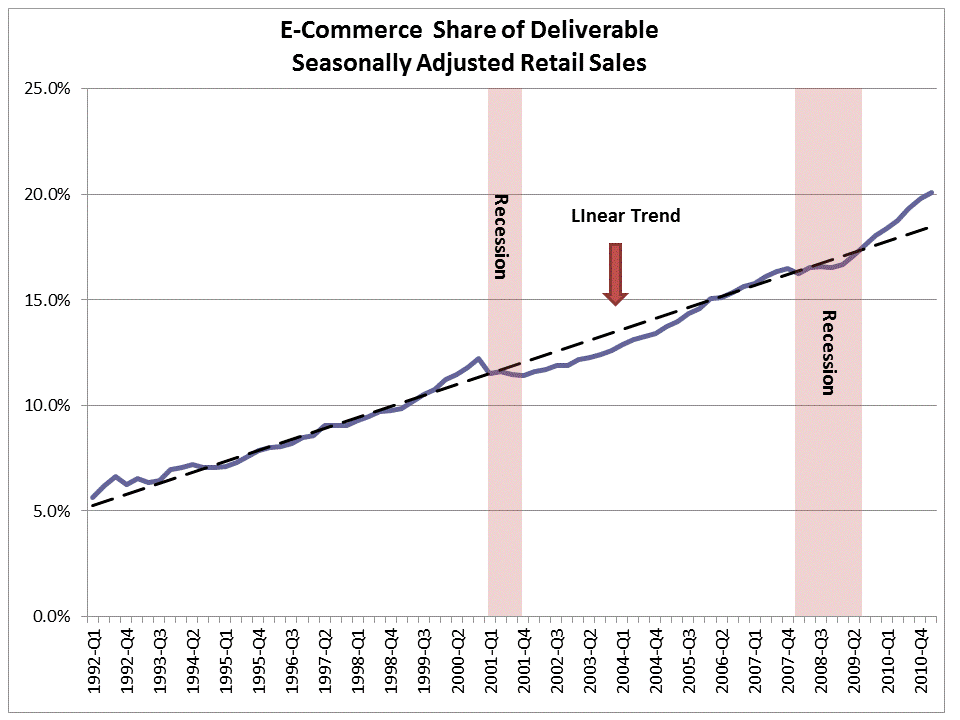
Readers of this blog are more familiar with the problems that the Postal Service faces these writers. They will have no problems identifying how the writers of the two pieces illustrated their minimal knowledge of the postal market or the USPS.
Common to both pieces is a misunderstanding of how limited the competition between the Postal Service and United Parcel Service and FedEx really is. The Postal Service is in the business of delivering documents, small parcels (those under 10 pounds) shipped by all senders, and larger parcels shipped by households and others that ship parcels infrequently. FedEx and UPS focus on business-to-business shipments and household deliveries of larger parcels. FedEx and UPS use the Postal Service to deliver small parcels to households as the revenue generated to drop one small parcel at a household is not equal to the cost of delivery for those two carriers. More of the Postal Service's volumes compete with newspapers like The Los Angeles Times and Washington Times, than with UPS and FedEx.
So why does what is printed now in two newspapers matter to postal stakeholders? They are important because they provide some hint as to what the debate over the future business models will look like. Right now, postal policy is most likely a low level priority of both the Obama Administration and Congress. Postal Policy is not a hot button issue in the blogosphere, talk radio, cable news except when used to illustrate why the financial health of the Postal Service suggests that public option is a bad idea.
This will change when the Government Accounting Office issues its report on potential business models in March or April of 2010 and the issue of postal operating losses and retiree healthcare payment schedules raise the threat of default on payroll next fall, and the risk that debt limit will be hit in 2011. Postal policy will bubble to the top of public discourse in the spring and summer of 2010 because the blogosphere, talk radio, and infotainment programs on the cable news networks will see postal policy as an issue that their readers and listeners can easily understand, or more importantly understand an ideological position relative to future postal business models.
The rise of postal policy in public discourse will be helped by the fact that the "hot button" issues of 2009 will have mostly be dealt with. This includes health care, financial industry reforms, and possibly even energy policy and global warning. At that time, there will be few other "hot button" issues on the plate of Congress that the blogosphere, talk radio, cable news can talk about that every reader, listener, or viewer will easily understand and writers, hosts, or panelists can easily frame the problems of the Postal Service around their ideological perspective.
The Washington Times editorial uses the Postal Service to present a polemic against government provided services. It links together a series of anecdotal stories about poor customer service at retail outlets and the inability of the Postal Service to meet its Priority Mail commitment with references to news stories illustrating evidence that its operating process are breaking down. In conclusion, the Washington Times does not present solution, instead it concludes with a remark suggesting that households abandon the Postal Service for parcel delivery.
The Los Angeles Times piece (reprinted in the Allentown Morning Call) is more thoughtfully written but David Lazarus but illustrates the types of conclusions that are drawn when based on misinformation provided by the Postal Service employees who have a real interest in maintaining the status quo, limited understanding of customers of and competition within the document and parcel delivery markets that results, and limited time to assess the information collected in interviews.
The remainder of this post reflects comments that I sent to Mr. Lazarus and represent my initial reaction to a number of the points that he raised.
Can this system be saved?
The answer is yes. However, it cannot survive as it does now. It is also clear from other countries that a postal service can provide universal service, even places as remote as the Australian outback and the Arctic areas of Canada at a uniform price. Put another way, is it time we privatized the postal service?I think the answer here is yes as well but not in the manner that you are thinking. By 2020, The Postal Service and mail in general will primarily be a means of delivering advertising. (It is close to that now.) What should the US Government's responsibility for advertising delivery be? Personal Correspondence is less 4% of all mail volume and bill payments by check will likely disappear by around 2030. (There is already no check clearinghouse in Great Britain or Sweden.)The question of privatization is often tied to the question of the monopoly. A privatized Postal Service does not require eliminating the monopoly. Examples of privately owned, legal monopolies exist among regulated utilities serving large territories and unregulated rural retail monopolies selling everything from gasoline to groceries.
"The postal service is asking for a national dialogue on this," Richard Maher, a Postal Service spokesman in Los Angeles said. "What is our role going to be in the future? We need to have a conversation about that."
The dialogue was mandated by Congress and GAO will have a report on the subject that the USPS is trying to influence at the end of March. They wrote a paper on the topic and hired 4 independent thinkers, including myself to look at the question. For more information go to www.postaljournal.com for links to all papers an links to presentations made on the topic at a recent conference in DC.
Who wants the take over the Postal Service's business?
The interviews with FedEx and UPS are reflective of their view. They do not want to get in the “mail” business because it is not a growth business like parcel shipping in Asia. They are being a little disingenuous as FedEx is the USPS’s largest transportation supplier. UPS is a significant supplier. Both use the USPS to deliver parcels under 5 pounds to households and to addresses that FedEx and UPS call “remote” For them, remote means many zip codes in outer suburbs of big cities. They also like having a competitor who is undercapitalized and a bit inefficient as it allows them to charge more for services in the US and use those profits to invest in faster growing markets abroad. They will be major players in policy debate to come.
If not UPS or FedEx who?
The only other US private sector firm who would be a logical buyer would be Pitney Bowes but the USPS might be too big for them to swallow. Similar problems would exist for foreign buyers, including Canada Post, Deutsche Post, and TNT Post Group. Buying the USPS, especially given its current financial position, business model, and restrictions on operations, customer relationships, etc would be not viewed as a viable proposition. Also, these companies, as well as UPS and FedEx have better uses of capital than in investing in the USPS. TNT has specifically indicated it is exiting the mail business outside of the Netherlands.
The big private shippers probably would be happy to cherry-pick profitable urban routes but would want nothing to do with having to schlep mail up and down unprofitable rural roads.
FedEx and UPS already do that with their pricing structure. The private carriers (they are carriers and not shippers; those that send stuff are shippers) have substantial surcharges on home delivery and “remote” delivery, and retail services, (e.g. anyone who does not have a corporate account) All of these surcharges makes the USPS cheaper for individual shippers of parcels and commercial shippers of light weight parcels to homes and remote areas. So they already cherry pick in the parcel business. There is some indication in Europe that entry into the mail delivery market even into the most high-volume high-income neighborhoods is difficult to do profitably Furthermore not all urban carrier routes are profitable as routes in low income urban neighborhoods have much less mail per stop than those in high income neighborhoods and "cream skimmers" may find that the number of routes that could be served profitably are too few to justify investment in a start-up delivery business.
It seems to me that the only privatization scheme that stands even a remote chance of working would be to break the postal service network into hundreds of regions and territories, and then have local companies compete for mail-delivery rights in each area. But you'd still have to wonder how any such private-sector players would be more successful at the game than a long-established heavyweight like the Postal Service.
Breaking up the Postal Service has been suggested before. The problem with this solution is that almost all buyers of mail service want the company that collects / accepts the mail to have the ability to seamlessly deliver to any address in the US. Mailers, and in particular larger mailers, want to maximize their purchasing leverage by buying from one or two transportation sources not 50. That is why both FedEx and UPS have national parcel, express and freight networks and ATT, Sprint, T-mobile, and Verizon all offer nationwide wireless service. The privatization scheme that would have the best chance of working would be an IPO with a significant employee ownership. It could come only after the USPS could show it could operate profitably under private sector business and employment law. This is what happened with Conrail in the 1980’s.
"If the system was privatized, it might cost 44 cents to get a letter across Los Angeles but $5 to get it to Connecticut," said Richard Maher, the postal service spokesman. "When you think about a network that delivers to all homes every day -- it's huge," he said. "Would a private company be able to do that? I don't think so. I think we would lose universal service."
These are canards. Every country uses a uniform rate for single-piece mail and in many cases for Parcels. (look at the rate structure for parcel in Germany where you can send a parcel anyplace in the world and only have to choose among some 20 or so rates based on the size of the box and the destination country.) Business mailers (LL Bean, Bank of America, etc, may see rates that are not uniform. In fact, those advertising mailers that drop their mail at local post offices rather than anyplace in the country already have the distance based rates that Mr. Maher says would be so terrible. If distance based rates are introduced to First Class for commercial mailers, percentage differences between local and distant rate will likely be much less than 100% rather than the 1,136% that the Postal Service spokesman describes.
The percentage difference between local parcels and those shipped cross-country vary with weight. The percentage does not exceed 100% until the parcel exceeds 17 pounds. This suggests that the impact of transportation on rates for items that are sorted at origin and destination would be quite small.
The Universal Service Obligation (USO) argument has been gone over many times. The driver of the USO is commercial mailers, who must mail to every possible address. The rates charged these mailers can be set to cover the total cost of delivering to every address printed on their mail using either a uniform or distance-based rate. The acceptance of remote surcharges by customers or FedEx and UPS illustrate that private sector carriers can devise non-uniform rates that allow them to deliver to all addresses in all 50 states. UPS and FedEx have a common carrier obligation which creates a common law requirement to actually deliver to all points that they say they reach according to advertised service commitments. Similar obligations exist for other trucking, rail, air and telecommunication carriers and are enforced by regulators and courts. In addition, there are lots of publicly traded utilities that provide “universal service” as it is within their charter to offer the service to every potential customer. With a common carrier obligation, the only financial problem for the Postal Service would be developing rates that cover the costs of single-piece mail sent or received by single piece mailers in the nation's most rural areas as defined by the Department of Agriculture.
Moreover, why limit the system's network of post offices to stamps and boxes? Why not have the post office deal in all manner of communications, from book and cell phone sales to DVD rentals? Heck, why not sofas, lattes and Wi-Fi access?
I agree with you that the USPS should be able to do more beyond what it does now. I also believe that just as private health insurers did not want a public option to compete with them, Starbucks, ATT, Amazon, Banes and Nobel, Citibank, and all kinds of other firms in the private sector do not want a government entity competing with them. In the United States we do not have a tradition of having a government entity actively competing with the private sector. Also the employment laws and business laws that apply to the government do not work really well for an entity like the USPS that gets 70% of its revenue now from customers that mail more than 500 pieces at a time. If the Postal Service must expand outside traditional mail business, then the only choice is a corporate private-sector model for the Postal Service.
This brief post illustrates the massive education effort that lies ahead for stakeholders in the mail industry. Editorial writers and business journalists have influence far beyond the few people who buy their papers and contacting them individually or in groups will be critical for stakeholders. But stakeholders can not stop there as the primary source of news and opinion on the future of mail will come from the web, talk radio and cable news. The tea-party movement shows how the internet, talk radio and cable news could drive and amplify a public policy issue that every voter uses, has a personal connection to, and can develop a vision for its future based on their political ideology and personal interests. With the Government Accounting Office report coming out this spring, it is time for stakeholders to begin this effort. Without it, Congressional reaction to the report will be driven by influences whose livelihoods and businesses do not depend on the future of mail.
Saturday, December 12, 2009
Purolator USA, Canadian in the US Parcel Market
When DHL exited from its United States domestic business, most commentators suggested that shippers would face only the duopoly of UPS and FedEx. The Postal Service was considered a marginal player that could not meet the service quality needs of business to business customers. More importantly, it rarely was price competitive on shipments over 5 pounds.
In a previous post, I noted that Amazon in its drive to shorten the time from order to delivery is expanding the number of competitors that compete in the parcel delivery market as it uses same-day couriers to delivery parcels that UPS or FedEx would have delivered previously. Amazon can expand the list of potential vendors to include same day and regional parcel carriers because its warehouses are close to the customers that it wants to serve but can only be served by carriers that can operate with more flexibility than the two national carriers.
New competition in the United States does not just come from these regional carriers. Purolator USA, a Canada Post subsidiary, is slowly expanding its domestic United States business as a complement to its cross-border business. By expanding its domestic United States business, it can serve more of the North America needs of its customers, making it easier for it to get a larger share of the business of customers with significant cross-border parcel and express traffic.
The growth of Purolator USA can be seen by looking at its web site and some of the older items that Purolator has not updated. Purolator, operating as a subsidiary of the Canadian courier has been in the United States since 1997, and under the Purolator USA name since 2004. For most of its existence, its focas has been on cross border traffic into Canada where it is the largest parcel and express carrier.
In its brochure describing its cross-b0rder service, Purolator describes four (4) United States based consolidation terminals in Seattle, New York, Buffalo and Chicago. It's website now lists the ten (10) gateways listed below. Clicking on any of the gateways will show the service times that Purolator USA promises to customers served by that gateway. The maps are comparable to service times of UPS and FedEx but somewhat narrower than what is offered by some regional carriers.
(Readers using Internet Explore may have some difficulties with some of these downloads as you have to tell IE that you want to download the file and then try a second time. They all work fine in Firefox. If you have a fix send a comment.)
Buffalo, NY
Dallas-Fort Worth, TX
Itasca, IL
Los Angeles, CA
Melville, NY
Newburgh, NY
Philadelphia, PA
Raleigh-Durham, NC
Seattle, WA
Taylor, MI
The growth in gateways, and the service area of each gateway suggests that Purolator USA is growing its cross boarder business and using that growth to organically grow regional and inter-regional traffic within the United States. This is similar to the strategy that Roadway Package Express used to grow the ground network from scratch that is now FedEx Ground. This contrasts with the failed strategy of DHL to buy US market share by buying Airborne, a company that at best was marginally profitable as an independent firm. Purolator USA's strategy in the United States domestic market has a reasonable chance of success if it can offer domestic US service as good as the cross-border service it offers its customers as well as the service offered by UPS and FedEx.
Given the success of numerous regional carriers, Purolator USA may now be enticed to speed the process by buying profitable regional operators. The DHL experience will likely ensure that any mergers are pursued cautiously and will likely focus on regional operators in areas that it does not now have gateways.
Purolator USA's domestic service unlikely provides more than a fraction of 1% of the total US domestic parcel and express market. However, even niche competitors can have an impact on the pricing strategies of UPS and FedEx as they negotiate with US customers that currently use Purolator for Canadian destined shipments.
In a previous post, I noted that Amazon in its drive to shorten the time from order to delivery is expanding the number of competitors that compete in the parcel delivery market as it uses same-day couriers to delivery parcels that UPS or FedEx would have delivered previously. Amazon can expand the list of potential vendors to include same day and regional parcel carriers because its warehouses are close to the customers that it wants to serve but can only be served by carriers that can operate with more flexibility than the two national carriers.
New competition in the United States does not just come from these regional carriers. Purolator USA, a Canada Post subsidiary, is slowly expanding its domestic United States business as a complement to its cross-border business. By expanding its domestic United States business, it can serve more of the North America needs of its customers, making it easier for it to get a larger share of the business of customers with significant cross-border parcel and express traffic.
The growth of Purolator USA can be seen by looking at its web site and some of the older items that Purolator has not updated. Purolator, operating as a subsidiary of the Canadian courier has been in the United States since 1997, and under the Purolator USA name since 2004. For most of its existence, its focas has been on cross border traffic into Canada where it is the largest parcel and express carrier.
In its brochure describing its cross-b0rder service, Purolator describes four (4) United States based consolidation terminals in Seattle, New York, Buffalo and Chicago. It's website now lists the ten (10) gateways listed below. Clicking on any of the gateways will show the service times that Purolator USA promises to customers served by that gateway. The maps are comparable to service times of UPS and FedEx but somewhat narrower than what is offered by some regional carriers.
(Readers using Internet Explore may have some difficulties with some of these downloads as you have to tell IE that you want to download the file and then try a second time. They all work fine in Firefox. If you have a fix send a comment.)
Buffalo, NY
Dallas-Fort Worth, TX
Itasca, IL
Los Angeles, CA
Melville, NY
Newburgh, NY
Philadelphia, PA
Raleigh-Durham, NC
Seattle, WA
Taylor, MI
The growth in gateways, and the service area of each gateway suggests that Purolator USA is growing its cross boarder business and using that growth to organically grow regional and inter-regional traffic within the United States. This is similar to the strategy that Roadway Package Express used to grow the ground network from scratch that is now FedEx Ground. This contrasts with the failed strategy of DHL to buy US market share by buying Airborne, a company that at best was marginally profitable as an independent firm. Purolator USA's strategy in the United States domestic market has a reasonable chance of success if it can offer domestic US service as good as the cross-border service it offers its customers as well as the service offered by UPS and FedEx.
Given the success of numerous regional carriers, Purolator USA may now be enticed to speed the process by buying profitable regional operators. The DHL experience will likely ensure that any mergers are pursued cautiously and will likely focus on regional operators in areas that it does not now have gateways.
Purolator USA's domestic service unlikely provides more than a fraction of 1% of the total US domestic parcel and express market. However, even niche competitors can have an impact on the pricing strategies of UPS and FedEx as they negotiate with US customers that currently use Purolator for Canadian destined shipments.
Sunday, December 6, 2009
Amazon: Avoiding the Post Office
In Rethinking the Parcel Market, I noted Amazon's effort to offer same day delivery and what that means for UPS, FedEx and the Postal Service in the United States. Today's Times Online reports that Amazon has launched "a secret search for bricks-and-mortar stores to support its rapidly growing website. It is understood to be scouring the country for high-profile sites."
According to the article, Amazon is not looking to open retail outlets where customers can buy goods that the store has in inventory. Instead, the stores will provide a delivery point for customers that order larger items that mail or truck delivery is inconvenient.
[Monday 12/7/2009 Amazon has subsequently denied the story. Given the success of Apple stores and Amazon's success in revolutionizing the retail supply chain, the idea that Amazon would add a brick and mortar option seems logical. The brick and mortar option clearly fits with Amazon's clear interest in reducing the time from order to delivery. The post was edited following its original posting to reflect why Amazon may have explored the possibility of retail even if it has for now rejected the available brick and mortar options.]
Amazon's move if completed would put it in direct competition with Argos, Tesco and John Lewis which all offer similar services. The Times reports that Argos' customers pick-up 18% of their Internet purchases in brick and mortar outlets rather than have the items delivered by parcel carrier or road transport. Argos will generate half of their television sales this Christmas via the combination of a purchase on the Internet and delivery to a brick and mortar outlet.
If Amazon goes ahead with a retail strategy, it should be able to haul items for pick-up to its "stores" using contract carriers dedicated to their retail network. Amazon's business case would most likely show that both customers prefer to pick-up their larger items at a retail outlet and the overall delivery costs, including the cost of operating retail outlets, is less than the cost of home delivery. Amazon could then decide to hold some inventory of fast moving items at retail outlets to further reduce costs and allow for same day pick-up of these items. For this strategy to be successful, the customer's experience in retail outlets has to be just as good as the experience on the website.
A retail initiative by Amazon's would be a direct assault on Royal Mail, DHL, UPS, TNT, FedEx and road transport companies that handle items that weigh over 75 pounds (34 kilo). The reported new initiative would also be a direct assault on retail outlets of Royal Mail and its competitors that could provide a similar service to replace the loss of sales as single-piece letter mail volume decline.
Amazon is unlikely to pursue a similar strategy in the United States. Pursuing this strategy in the United States could require Amazon to collect sales taxes on sales in those states where it opened retail outlets. Losing the sales tax advantage would eliminate a price advantage that Amazon has over Best Buy, Sears and other s that offer store pick-up of Internet sales. Given the peculiarity of U.S. tax law there is an opportunity for FedEx, UPS, and the Postal Service to work with Amazon to expand the hours of a limited set of their retail outlets to make them pick-up points for Amazon and other Internet retailers. Alternatives any of these competitors could follow the lead of the German and Danish Post Offices and open self-service lock-boxes for after hours parcel delivery.
According to the article, Amazon is not looking to open retail outlets where customers can buy goods that the store has in inventory. Instead, the stores will provide a delivery point for customers that order larger items that mail or truck delivery is inconvenient.
[Monday 12/7/2009 Amazon has subsequently denied the story. Given the success of Apple stores and Amazon's success in revolutionizing the retail supply chain, the idea that Amazon would add a brick and mortar option seems logical. The brick and mortar option clearly fits with Amazon's clear interest in reducing the time from order to delivery. The post was edited following its original posting to reflect why Amazon may have explored the possibility of retail even if it has for now rejected the available brick and mortar options.]
Amazon's move if completed would put it in direct competition with Argos, Tesco and John Lewis which all offer similar services. The Times reports that Argos' customers pick-up 18% of their Internet purchases in brick and mortar outlets rather than have the items delivered by parcel carrier or road transport. Argos will generate half of their television sales this Christmas via the combination of a purchase on the Internet and delivery to a brick and mortar outlet.
If Amazon goes ahead with a retail strategy, it should be able to haul items for pick-up to its "stores" using contract carriers dedicated to their retail network. Amazon's business case would most likely show that both customers prefer to pick-up their larger items at a retail outlet and the overall delivery costs, including the cost of operating retail outlets, is less than the cost of home delivery. Amazon could then decide to hold some inventory of fast moving items at retail outlets to further reduce costs and allow for same day pick-up of these items. For this strategy to be successful, the customer's experience in retail outlets has to be just as good as the experience on the website.
A retail initiative by Amazon's would be a direct assault on Royal Mail, DHL, UPS, TNT, FedEx and road transport companies that handle items that weigh over 75 pounds (34 kilo). The reported new initiative would also be a direct assault on retail outlets of Royal Mail and its competitors that could provide a similar service to replace the loss of sales as single-piece letter mail volume decline.
Amazon is unlikely to pursue a similar strategy in the United States. Pursuing this strategy in the United States could require Amazon to collect sales taxes on sales in those states where it opened retail outlets. Losing the sales tax advantage would eliminate a price advantage that Amazon has over Best Buy, Sears and other s that offer store pick-up of Internet sales. Given the peculiarity of U.S. tax law there is an opportunity for FedEx, UPS, and the Postal Service to work with Amazon to expand the hours of a limited set of their retail outlets to make them pick-up points for Amazon and other Internet retailers. Alternatives any of these competitors could follow the lead of the German and Danish Post Offices and open self-service lock-boxes for after hours parcel delivery.
Labels:
Amazon,
DHL,
post office,
Royal Mail,
TNT,
United Parcel Service,
United States Postal Service,
UPS
Subscribe to:
Posts (Atom)


