Seeking Alpha has published the full transcript of the FedEx 4th quarter and year end conference call that was held yesterday. Anyone interested in the express, parcel, air freight or trucking markets should read the full transcript.
Below are some excerpts that illustrate how e-commerce is changing FedEx's business.
From the opening statement of Alan Graf, Executive Vice President and CFO
Looking now at the Ground segment. Revenues climbed 15% to $2.26 billion, while operating income soared 31% to $417 million. Operating margins hit an all-time quarterly record of 18.4%. Revenue per package increased 7% primarily due to yield management actions. And package volume grew 6%, driven by increases in the business-to-business market and Home Delivery service. SmartPost average daily volumes surged 24% due to the growth in e-commerce, while yields increased 8%.
At Ground, we expect strong operating income growth due to efficiency improvements such as automated operational planning systems and improved transit time across numerous shipping lines. Segment revenue growth will be led by a continued growth in commercial, Home Delivery and SmartPost volumes resulting in additional market share gains. SmartPost is expected to continue to strengthen its market position by continuing to leverage the FedEx Ground network to insert at the optimal United States Postal Service entry point. Yields for FedEx Ground are also expected to improve as a result of our yield management initiatives and improved market penetration for our FedEx Home Delivery services.
Comments on Economic Growth from Mike Glen President of FedEx Services
There is no question that we're in a soft patch right now largely due to transitory issues such as the Japan supply chain disruptions. Obviously, we had a tremendous amount of weather impact, and the oil prices that were on the rise during the quarter. So we had some economic challenges during the quarter. We expect the GDP to accelerate through the calendar year. Our projections on a quarter-by-quarter basis for GDP in the second quarter is 1.9%; third quarter, 3.5%; and then the fourth quarter, 3.4%. So for calendar '11, we're anticipating 2.5% GDP growth; and in calendar '12, 3.0% GDP growth, with industrial production around 4.2%, 4.3%.
Comments on how SmartPost serves e-commerce customers from Mike Graf
SmartPost is a key part of our residential delivery portfolio. Obviously, there are a lot of very light weight items that move to residences that are perfect for the SmartPost network, which is why we invested in that network and have continued to invest in that network going forward. It gives us a distinct competitive advantage because it offers the right price point for the right value delivery system and complements our Home Delivery network very well. It allows us to focus the Home Delivery network on heavier packages, and many of which that require unique features that only FedEx offers such as day-definite delivery, appointment delivery and things of that nature. So it is a strong combination of services, complemented by our Express residential delivery services, which offers unique value for e-commerce customers.
Comments of Fred Smith on Consumer Spending and the peak season
It's certainly early to really start that. We have started planning and having some conversations with customers, but they have not released their forecasts. I would say the encouraging news on that front as oil prices subside, we do anticipate consumer spending to be stronger in the second half of the year. So hopefully, we'll see some of that going into peak season, but it's a bit early to make that call.
Comments of Mike Glen on Business Growth and Consumer Spending
But obviously, oil prices was a big part of that, disruptions in the Japan supply chain were a big part of that. While that is recovering, we still are seeing impacts of that and we're not back up to speed in that regard. The sentiment on the consumer side continues to be an issue. As a result, our forecast for consumer spending in the first half of this calendar year is lower than it is in the second half as we believe that, that will improve in the second half of the year. So that's been the biggest issue. Those have been the biggest 3 factors that we've been saying that have resulted in this soft patch.
Showing posts with label FedEX. Show all posts
Showing posts with label FedEX. Show all posts
Thursday, June 23, 2011


Wednesday, June 22, 2011
FedEx Earnings and SmartPost and Parcel Select
FedEx announced its earnings today. The Associated Press reported that earnings were ahead of analyst expectations. FedEx is forecasting strong earnings growth in its First Quarter, 2012 (which starts June 1, 2011) and all of its FY 2012
FedEx Ground delivery volume grew 6% in the quarter which is stronger than total industry growth. This growth was paced by FedEx SmartPost where "average daily volume increased 24% due to growth in e-commerce and gains in market share. FedEx SmartPost revenue per package increased 8% primarily due to growth in higher-yielding services and increased fuel surcharges."
Since 2008, FedEx SmartPost has grown from 4.9% of FedEx Ground Revenue to 7.4% of Ground Revenue in 2011. During the same period, FedEx SmartPost has grown from 15.5% to 27.7% of shipments that FedEx Ground picks up from its customers.
In the conference call a FedEx executive on the call made the following statements:
****
Implications for the Postal Service
FedEx's success with SmartPost raises questions about the success of the Postal Service's Parcel Select and Parcel Select Light products. Clearly FedEx's volume is growing faster than the Postal Service's reported volume. FedEx SmartPost appears to be taking market share away from other parcel consolidators that drop parcels at postal facilities. Also, the growth of FedEx SmartPost suggests that the Postal Service may have some pricing power in its parcel select products, particularly in terms of delivering light weight parcels for more remote locations, that it needs to explore as it tries to maximize profits from its parcel products.
FedEx Ground delivery volume grew 6% in the quarter which is stronger than total industry growth. This growth was paced by FedEx SmartPost where "average daily volume increased 24% due to growth in e-commerce and gains in market share. FedEx SmartPost revenue per package increased 8% primarily due to growth in higher-yielding services and increased fuel surcharges."
Since 2008, FedEx SmartPost has grown from 4.9% of FedEx Ground Revenue to 7.4% of Ground Revenue in 2011. During the same period, FedEx SmartPost has grown from 15.5% to 27.7% of shipments that FedEx Ground picks up from its customers.
In the conference call a FedEx executive on the call made the following statements:
- "Smart Post is a key part of a residential delivery portfolio.
- There are a lot of light weight items in that network.
- It gives us a competitive network.
- It allows us to focus our home delivery network on heavier items and items that require special features such as day definite or time definite delivery.
****
Implications for the Postal Service
FedEx's success with SmartPost raises questions about the success of the Postal Service's Parcel Select and Parcel Select Light products. Clearly FedEx's volume is growing faster than the Postal Service's reported volume. FedEx SmartPost appears to be taking market share away from other parcel consolidators that drop parcels at postal facilities. Also, the growth of FedEx SmartPost suggests that the Postal Service may have some pricing power in its parcel select products, particularly in terms of delivering light weight parcels for more remote locations, that it needs to explore as it tries to maximize profits from its parcel products.
Tuesday, June 14, 2011
On-line Sales Share of Retail Sales Hits New High
The U.S. Census Bureau retail sales data released today showed that in April, the share of retail sales that are sold on-line or via a catalog rose to 20.3% of retail sales from merchants selling products that are sold both in brick and mortar stores, on-line or through a catalog. This means that 20.3% of all retail sales that could be delivered by FedEx, United Parcel Service or the United States Postal Service, are being delivered by these firms. (Details on how the proportion is calculated is at the bottom of this post.)
April represents the fifth month in a row that on-line/catalog merchant sales were more than 20% of sales of items that could be delivered to a consumer were delivered to the consumer rather than purchased at a retail store A year ago 18.5% of sales of items that could be delivered to a consumer were delivered. The following chart shows retail sales data dating back to 1992 as provided by the Census Bureau.
 The chart also includes an exponential trend, and for the statistical geeks, the trend equation and R-squared. The trend line illustrates that the shift to on-line retailing has grown exponentially since data was available with deviations occurring only around the two recessions in the period graphed.
The shift to retail sales from on-line and catalog merchants may partially explain the decisions of American Eagle, Gap, Lowe's and other brick and mortar retailers to close stores or stop expansion as the total dollar sales at brick and mortar outlets stagnates as on-line and catalog sales grow.
The Courier, Express and Postal Observer will post the proportion of deliverable retail sales on a monthly basis going forward.
Explanation of Chart Data
The proportion illustrate in the chart represents the proportion of catalog and on-line sales estimated by the Census Bureau as a portion of sales at furniture & home furnishings (442), electronics & appliances (443), clothing & accessories (448), sporting goods, hobby, book, and music (451), general merchandise (452), office supply, stationery, and gift stores (4532) stores as well as on-line and catalog merchants (4541). [The numbers in parentheses are the NAICS codes used by the Census Bureau to classify businesses.]
As many retailers, (i.e., Walmart, JCPenney, Target, Best Buy, Limited Brands (Victoria's Secret, Bath and Body Works) and Best Buy) that currently generate most of their sales from brick and mortar outlets now generate a growing but small proportion of their total sales from their websites, this proportion represents a conservative estimate of the share of deliverable retail sales that FedEx, United Parcel Service or the United States Postal Service are delivering.
April represents the fifth month in a row that on-line/catalog merchant sales were more than 20% of sales of items that could be delivered to a consumer were delivered to the consumer rather than purchased at a retail store A year ago 18.5% of sales of items that could be delivered to a consumer were delivered. The following chart shows retail sales data dating back to 1992 as provided by the Census Bureau.

The shift to retail sales from on-line and catalog merchants may partially explain the decisions of American Eagle, Gap, Lowe's and other brick and mortar retailers to close stores or stop expansion as the total dollar sales at brick and mortar outlets stagnates as on-line and catalog sales grow.
The Courier, Express and Postal Observer will post the proportion of deliverable retail sales on a monthly basis going forward.
Explanation of Chart Data
The proportion illustrate in the chart represents the proportion of catalog and on-line sales estimated by the Census Bureau as a portion of sales at furniture & home furnishings (442), electronics & appliances (443), clothing & accessories (448), sporting goods, hobby, book, and music (451), general merchandise (452), office supply, stationery, and gift stores (4532) stores as well as on-line and catalog merchants (4541). [The numbers in parentheses are the NAICS codes used by the Census Bureau to classify businesses.]
As many retailers, (i.e., Walmart, JCPenney, Target, Best Buy, Limited Brands (Victoria's Secret, Bath and Body Works) and Best Buy) that currently generate most of their sales from brick and mortar outlets now generate a growing but small proportion of their total sales from their websites, this proportion represents a conservative estimate of the share of deliverable retail sales that FedEx, United Parcel Service or the United States Postal Service are delivering.
Sunday, May 22, 2011
Comparing Labor Cost Proportions at the USPS, UPS, and FedEx
Update: this chart in this post has been replaced to correct a silly error. The USPS delivers to residential addresses 6 days a week. I know that and I know that all readers of this blog know this as well. I would like to thank the reader who posted the comment that force me to fix this error.
In a discussion today on his Facebook page, Representative Dennis Ross fell into a common trap in comparing the labor's portion of costs by the USPS, UPS and FedEx. He states that:
The differences in the proportion of labor costs can come from one of six factors:
I have already presented a comparison of compensation levels between the Postal Service, UPS, and FedEx. The comparison showed that total compensation of Postal Service employees in a delivery function clearly fall in between the compensation of UPS and FedEx.
Employees who work inside processing facilities at the Postal Service on average are paid more than FedEx and UPS employees. However, the new APWU contract will result in Postal Service compensation falling in line with what compensation of UPS and FedEx. (It should be noted that UPS also offers significant college scholarships as a benefit to parcel sorting employees that are not included in these comparisons.) The compensation levels of the new class of APWU members that could include 20% of APWU employees are very competitive with compensation of individuals with similar experience at UPS and FedEx.
Employees that provide retail services at the Postal Service have no real comparison with employees at FedEx and UPS. Comparisons are usually made here with other retail occupations and bank tellers. I have not looked at this comparison but the data is available to make this comparison is available from both private and public sources.
Finally, compensation of UPS and FedEx executives are significantly higher than Postal Service executives. The compensation levels of managers and technical staff at UPS and FedEx are likely also higher.
On balance, it is unclear how much a compensation premium affects labor compensation's proportion of total costs.
Work Rules
Another factor that increases USPS compensation expenses are work rules used for mail processing, local transportation and retail services. The new APWU contract, and in particular the new method of defining a full time schedule should go far to eliminate work rules that requires the Postal Service to overstaff its processing and retail facilities. The new method of defining full time will likely result in employee schedules that are close to the part time schedules that FedEx and UPS use for its sortation centers.
Contracting
The following table illustrates how the Postal Service, UPS and FedEx use contractors.
Comparison of Contracting at the USPS, UPS, and FedEx


Focusing on unionized labor costs may be an easy political target for a Republican member of Congress. However, Congressman Dennis Ross would find his time better served if he now focused his time on examining, the Postal Service's financial goals, its capital structure and its real annual capital needs to replace the delivery fleet, optimize the network, modernize retail, upgrade the IT infrastructure and customer interfaces, and cover the transition costs of downsizing the workforce. By making this shift, Congressman Ross would make a real contribution to postal reform. His efforts would for the first time address one of the key failures of both the Postal Reorganization Act and the Postal Accountability and Enhancement Act, the failure to adequately recognize that "accounting break-even" is not an appropriate fiancial goal and that an under-capitalized Postal Service is an inefficient Postal Service.
In a discussion today on his Facebook page, Representative Dennis Ross fell into a common trap in comparing the labor's portion of costs by the USPS, UPS and FedEx. He states that:
UPS (Union) - about 66% of their total operating costs are labor. FedEx (non-union) - about 45% of their total operating costs are labor. USPS - 80-82%.
The differences in the proportion of labor costs can come from one of six factors:
- Compensation levels - what each company pays per hour worked
- Work rules - affects how efficiently each company uses employees
- Contracting - companies use different models regarding the use of contractors to handle the collection to delivery process, and in particular the labor-intensive delivery function
- Network differences - Differences in the network affects the amount of labor involved in delivery, sortation, transportation and retail portions of an end-to-end movement.
- Capital intensity - The companies have very different capital requirements that affect the amount of non-labor costs needed to provide the services that they offer.
- Congressional requirements - Congressional requirements focus on the aspects of the Postal Service that add significantly more labor costs while making minimal impact on capital spending.
I have already presented a comparison of compensation levels between the Postal Service, UPS, and FedEx. The comparison showed that total compensation of Postal Service employees in a delivery function clearly fall in between the compensation of UPS and FedEx.
Employees who work inside processing facilities at the Postal Service on average are paid more than FedEx and UPS employees. However, the new APWU contract will result in Postal Service compensation falling in line with what compensation of UPS and FedEx. (It should be noted that UPS also offers significant college scholarships as a benefit to parcel sorting employees that are not included in these comparisons.) The compensation levels of the new class of APWU members that could include 20% of APWU employees are very competitive with compensation of individuals with similar experience at UPS and FedEx.
Employees that provide retail services at the Postal Service have no real comparison with employees at FedEx and UPS. Comparisons are usually made here with other retail occupations and bank tellers. I have not looked at this comparison but the data is available to make this comparison is available from both private and public sources.
Finally, compensation of UPS and FedEx executives are significantly higher than Postal Service executives. The compensation levels of managers and technical staff at UPS and FedEx are likely also higher.
On balance, it is unclear how much a compensation premium affects labor compensation's proportion of total costs.
Work Rules
Another factor that increases USPS compensation expenses are work rules used for mail processing, local transportation and retail services. The new APWU contract, and in particular the new method of defining a full time schedule should go far to eliminate work rules that requires the Postal Service to overstaff its processing and retail facilities. The new method of defining full time will likely result in employee schedules that are close to the part time schedules that FedEx and UPS use for its sortation centers.
Contracting
The following table illustrates how the Postal Service, UPS and FedEx use contractors.
Comparison of Contracting at the USPS, UPS, and FedEx

The three carriers have very different operating models that significantly affect the portion of costs that show up in expenses as "compensation and benefits" and "contracted transportation" This makes comparisons particularly difficult as both UPS and FedEx use contractors extensively for retail services and FedEx Ground uses contractors to deliver all parcels.
An accurate comparison would identify the labor component of contracted retail, transportation, and delivery services. This is nearly impossible and is the primary reason that I have never presented a comparison of the proportion of labor costs in my previously published analyses of the parcel industry.
Network Differences
The following chart looks at differences in the networks employed by the USPS, UPS and FedEx.
Comparison of USPS, UPS, and FedEx Networks

The Postal Service's delivery network is significantly more extensive than either UPS or FedEx and primarily delivers to residential addresses that are more expense to serve than business address due to volume of deliveries per delivery point. Delivering 6-days to residential addresses increases the proportion of labor costs as capital expenses for buildings and vehicles are the same whether the Postal Service delivered 5 or 6 days per week, and some operating costs (heating fuel and electricity) do not change as much as labor costs. [added 5/23/2011 3:15 pm along with corrected chart]
The Postal Service network has significant overcapacity. To the extent that there is overcapacity in either UPS or FedEx's network it would affect short-term economic impacts or changes in population and economic growth across the United States. Also both UPS and FedEx are face the prospects of growing volumes so they face some challenges of having sufficient capacity while the Postal Service faces shrinking volumes so its network faces the prospect of increasing levels of overcapacity and the prospect that over time existing facilities will be in sub-optimal locations.
The Postal Service's retail network focuses on less knowledgeable buyers of the services that it offers. Also, the Postal Service's network faces regulatory and legislated constraints that neither UPS nor FedEx face.
Capital Intensity
Capital intensity affects the proportion of costs that are labor costs. Companies that are more capital intense have a lower portion of labor compensation costs and vise versa. For example, an electric utility is a more capital intense business than a nationwide retail chain. The following chart illustrates differences in capital intensity between the delivery services offered by the USPS, UPS, and FedEx.
Comparison of Capital Intensity of USPS, UPS and FedEx

FedEx has the most transportation capital needs as they operate the largest fleet of freighter airplanes in the United States. UPS has the second largest fleet of freighter airplanes. Both FedEx and UPS use their aircraft to fly Postal Service mail and parcels, relieving the Postal Service from making substantial capital investments. The Postal Service's transportation needs focus on its delivery fleet. However, it has not had the capital needed to replace its aging fleet, so its capital spending on transportation assets are below what may be required for cost-efficient operations.
Both FedEx and UPS are among the leaders in information technology spending among transportation companies. They both look at their IT investments as a competitive advantage. The Postal Service, on the other hand, has tended to underspend on information technology resulting in long implementation schedules for needed infrastructure, management information systems, customer information and transaction systems, and track and trace systems for mail and parcels.
Finally, both UPS and FedEx have managed their processing network using network models for years without constraints set by Congress on closing or moving operations. When additional facilities are needed, or upgraded to ensure proper maintenance and worker safety, they have the resources to make these investments. The Postal Service is limited to use the facilities that it now has and faces significant backlogs in facility maintenance. To the extent that facilities are located in the wrong location, or too small to handle sortation of a larger geographic territory, the Postal Service does not have the capital to make those investments.
Congressional Requirements
The Postal Service face two requirements from Congress that increase the labor cost's proportion of total costs.
- Restrictions on how retail services are provided - Both regulatory and legal restrictions on the Postal Service's retail network increase the proportion of total costs that are labor costs. These costs come from both operating a retail network and managing the process to implement changes in the network. In addition, Congressional efforts to slow changes to the retail networks add additional labor costs to managing the network to handle questions and concerns of members of Congress.
- Restrictions on delivery frequency - Requiring the Postal Service to provide delivery services 6 days a week has a larger marginal impact on labor costs than it does on all other expenses. The proportion of labor costs would be lower if the Postal Service only delivered mail 5 days per week.
Conclusion
Comparing the proportion of labor costs at the Postal Service with the proportion of labor costs at FedEx and UPS is a nonsensical exercise. It tells one little about what the appropriate proportion would be for an efficient or properly capitalized Postal Service.
Wednesday, May 11, 2011
Why Mail Matters: Newegg

Dear Alan M Robinson,
Thank you for shopping at Newegg.com. We're glad we had what you're looking for!
Your tracking number has been generated via Egg Saver. Please see below for your order information and tracking number. It may take up to 1 business day for your tracking information to become available.
Egg Saver shipments are picked up from our warehouse at the close of each business day by DHL Global Mail, who handles shipping from Newegg to your nearest USPS facility. USPS then delivers the package to your ship-to address with your regular mail delivery within 4-7 business days. [Words are bold in the original email.]

Now, the graphic is nice but isn't it a bit too complicated for Newegg customers who don't know what a DDU, SCF, BMC, or an AMF are? But it does make it clear that the shipment will arrive in the mail after being transported much of the way by DHL. (DHL should develop a new graphic for inclusion in e-mails like this designed for non-mailing industry customers of Newegg.)
The description of the service clearly illustrates a marketing and operations problem that the Postal Service has to fix if it wants to take a larger share of the Newegg's delivery business. Doesn't the sentence, "USPS then delivers the package to your ship-to address with your regular mail delivery within 4-7 business days," encourage customers to pay to upgrade to faster service the next time they make an order? Doesn't this sentence make signing up for either Amazon Prime or Shoprunner to get 2-day service at no charge if one shops online frequently?
Even with much slower service commitments, the Postal Service has been able to grow its last mile delivery business. In the First quarter of FY 2011 parcel select volume was up 26%, allowing its first-mile partners to cost-effectively drop shipments nearer to the delivery point.
The Postal Service's last mile, parcel delivery service could grow faster if it had tighter delivery standards so DHL would no longer say the "USPS then delivers the package to your ship-to address with your regular mail delivery within 4-7 business days." For example, the USPS needs to find a way to deliver shipments dropped at a DDU or SCF the next delivery day, and shipments dropped at a National Distribution Center (NDC) in two or three days. Then its service would nearly service competitive with ground delivery offerings of FedEx and UPS to merchants trying to satisfy demanding customers, while still offering the low-cost delivery option that makes on-line purchases attractive.
Why Mail Matters: Macy's

Macy's today announced its First Quarter 2011 earnings this morning and provided another clear indication that the courier, express and postal industry provide the an increasingly important role by delivering web based sales to consumer's homes.
The description of Macy's sales in the press release provides an indication as to how important web-sold and home-delivered sales are to Macy's
Sales in the first quarter of 2011 totaled $5.889 billion, an increase of 5.7 percent, compared with sales of $5.574 billion in the same period last year. On a same-store basis, Macy’s, Inc.’s first quarter sales were up 5.4 percent. Online sales (macys.com and bloomingdale's.com combined) were up 38.3 percent in the first quarter. Online sales positively affected the company’s same-store sales by 1.3 percentage points in the first quarter. Online sales are included in the same-store sales calculation for Macy's, Inc.

A back of the envelope calculation provides a rough idea what this growth means to FedEx, UPS and the Postal Service.
- For on-line sales to have such a large impact on Macy's total same store sales, home web-based and home-delivered sales has grown from 14.5% to 18.4% of Macy's retail revenue.
- If one assumes that an average shipment has a $200 invoice amount, Macy's first quarter home deliveries grew from just under 4 million in 2010 to 5.4 million.
- If Macy spends on average $7 per shipment, then it spent nearly $40 million on parcel delivery and express charges in the quarter.
Instead, shipments need to be sent from warehouses to homes. All three carriers are working to adapt to this change.
One of the results is the growth of the Postal Service's Parcel Select and Parcel Select Return services as these services fit the needs of Macy's for inexpensive and reliable home delivery. The challenge for the Postal Service is to try to figure out how it can improve its ability to integrate the last mile with the first miles of other carriers to reduce the time from order-to-delivery and make the customer's delivery experience as good as the products Macy's sells.
Wednesday, April 27, 2011
The US Parcel Market: Hightlights from the UPS Conference Call

Revenue Generated Per Shipment is Rising
Kurt Kuehn, the CFO described the improvement in revenue as follows:
Revenue per piece grew 5% with the biggest driver being increases in base rates, as we get our prices back in line with the value we provide.
Higher fuel surcharges and package characteristics also contributed to the yield improvement. We are executing our strategy of focusing on the quality of revenue. The key objective of this strategy is to ensure that we are properly compensated for the value we provide customers. And this is paying off as evidenced by our strong yield gains.
Mr. Kuehn's statement suggests that customers have had limited leverage in resisting the 4.9% rate increases implemented January 3, 2011.
Scott Davis, in response to a question of Ed Wolfe of Wolfe Trahan & Co. noted that UPS is taking a firm stance in pricing negotiations in order to get prices up to levels that they want. The impact of this change in negotiating posture impact may be modest as many customers have multi-year contracts.
The shift in package characteristics that Mr. Keuhn mentioned that would yield more revenue per package most likely reflects an increase in the proportion of shipments that are delivered to a homes
Package Market and GDP
In response to a question by Garrett Chase of Barclays Capital, Scott Davis noted a disconnect between industrial production levels and demand for parcel shipping. Parcel shipping demand did not decline as much as industrial production during the recession and is not rebounding as fast after. This may be another indication of the importance of the link between parcel shipping and retail markets.
The Impact of Oil Prices on GDP
Scott Davis in response to a question by Nathan Brochmann of William Blair & Company provides the rule of thumb that UPS may be using to estimate the impact of rising oil prices on GDP.
I think the rule of thumb for economists are that if oil prices go up $10 a barrel, it's going to knock down GDP about 0.02% in the year 1, about 0.5% in year 2. We've seen about $30 run in crude oil, so that could certainly have an impact in 2012, knock out about half the growth.
UPS and Labor Costs

UPS also indicated that its head count was likely to remain steady if economic growth continues at the current forecasted pace. If it stalls, it could see some reductions as efficiency improvements reduce demand for drivers and parcel sorters.
Large verses Small and Medium Sized Shippers
Both Scott Davis and Kurt Keuhn noted that large global enterprises have recovered faster from the recession than small and medium sized enterprises in response to a question from Jon Langenfeld of Robert W. Baird. They indicated that the real challenge facing these firms is access to credit which they expect to improve later this year.
Improvement in shipping volumes from smal and medium sized enterprises is important for the parcer and express carriers as these firms are offered smaller discounts off of list rates than larger firms. Increases in the share of business from this market segment should help improve carrier yields (revenue per package) and profitability.
B-2-B and B-2-C Markets
In a response to a question from Bill Greene of Morgan Stanley, Kurt Keuhn stated that B-2-C now represents one-third of United Parcel Service's volume. He further stated that B-2-C is growing faster than B-2-B volume.
This response provides a further indication that 1) the increase in yield is driven by home delivery surcharges, and 2) UPS's business success is increasingly tied to the success of e-commerce.
Market Competition
Kurt Keuhn described the parcel and express market as "extremely competitive." He went on to state:
Customers have multiple choices, and so we're out there competing like crazy. The comparisons to our competitors are a little confusing because some of them are use a different calendar. FedEx, for example had the December in their last quarter, which makes comparisons a little unusual. And we haven't heard yet from the post office, which is another very large player. We suspect they'll show negative results.
UPS clearly is concerned about competition from FedEx. It looks at the Postal Service as a less significant competitor. No mention was made regarding competition from regional and local parcel carriers or foreign-owned operators like Purolator International.
The problems that the Postal Service is having competing in the parcel market are worth studying. It is unclear whether the Postal Accountability and Enhancement Act provided the Postal Service with sufficient commercial freedom to set rates and negotiate with customers to allow its parcel business to grow at a rate equal to market growth.

Sunday, April 24, 2011
The Rise of E-commerce - How does it affect FedEx, USPS, and UPS?
E-commerce in the fourth quarter of 2010 for the first time clearly represented more than 20% of all deliverable retail sales. E-commerce's share of retail sales grew by a third in less than 5 years.
The following graph illustrates the change in share of seasonally adjusted retail sales.
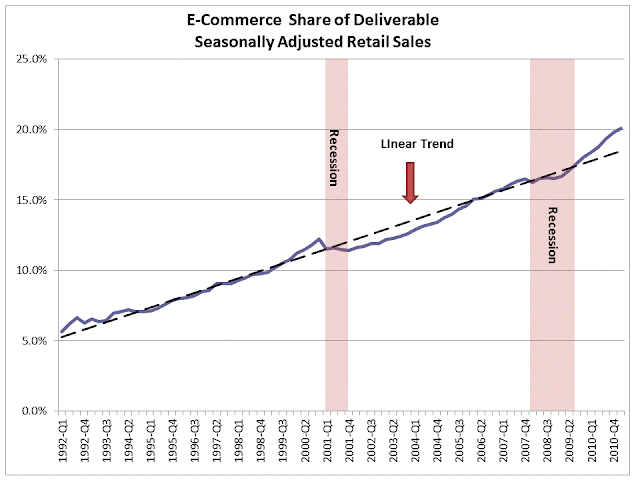 The 20% figure represents the proportion of catalog and on-line sales estimated by the Census Bureau as a portion of sales at furniture & home furnishings (442), electronics & appliances (443), clothing & accessories (448), sporting goods, hobby, book, and music (451), general merchandise (452), office supply, stationery, and gift stores (4532) stores as well as on-line and catalog merchants (4541). [The numbers in parentheses are the NAICS codes used by the Census Bureau to classify businesses.] As many retailers, (i.e., Walmart, JCPenney, Target, Best Buy, Limited Brands (Victoria's Secret, Bath and Body Works) and Best Buy) that currently generate most of their sales from brick and mortar outlets now generate a growing proportion of their total sales from their websites, this proportion represents a conservative estimate of the share of deliverable retail sales that FedEx, United Parcel Service or the United States Postal Service are delivering.
The chart above also illustrates, that for most of the period since 1992, delivered retail sales grew as a share of deliverable retail sales has grown by around 50% about every 7 years ( i.e. 6.67% to 10%, 10% to 15%). Since 2005 the rate of growth in delivered market share has quickened and the fifty percent growth rate to a 22.5% market share should come sometime near the end of next year.
The shift of retail from brick-and-mortar to catalog and e-commerce sales will have a profound impact on the retail supply chain, local economies and demand for print communications.
The retail supply chain over the next decade will have little choice but focus on home delivery. Lower-cost deliveries by parcel carriers and other firms to retail outlets will decline while higher-cost deliveries to homes will increase. The need for pick-up locations for high value items will grow which will increase the market for delivery lockers like those used by Deutsche Post, Post Danmark and DHL.
The growth of e-commerce sales will also increase both shorter-haul deliveries from warehouses within carrier one-day, and to a lesser extent two-day delivery windows. The growth of short haul traffic will also allow regional carriers to continue to grow their market share in more densely populated regional markets.
Finally e-commerce sales provide opportunities for integrated carriers like FedEx and UPS. These carriers can manage home deliveryof high-demand, and high-value items that companies like Apple Computer ship direct from warehouses near the manufacturers in China and other countries in the Pacific Rim.
The impact of delivered retail sales on many local economics is significantly negative. Many communities have a retail infrastructure that reflects a world where less than ten percent of all sales were delivered. Shopping malls and strip centers with vacant store fronts will find it more difficult to rent vacant space and will look to non-traditional and more than likely lower paying tenants like government agencies, libraries, medical and dental offices, and service providers like nail salons. Fewer retail stores mean not just fewer retail jobs but also fewer jobs required to build and maintain retail outlets. Lower brick-and-mortar retail sales will have the effect of lowering gasoline consumption as trips to the store are replaced by trips to the computer. To the extent that restaurant and fast food sales are tied to retail shopping, those sales will slip as well.
The shift of retail sales will have some positive impact on communities located near ideal distribution points that can take advantage of one-day delivery standards of ground parcel delivery. These communities should see growth in jobs in warehousing and transportation and may see some growth in other industries that will piggy-back on strengthened transportation infrastructure that e-commerce distribution supports.
Finally, the shift to on-line sales could have a devastating impact on print advertising, and in particular newspaper display ads and direct mail from local merchants. To the extent that on-line sales cause brick and mortar retailers to go bankrupt, the trend removes print advertisers from the marketplace. Remaining retailers may not be willing to pay as much for advertising as the firms they replace. Adding to the challenge facing print advertising is that the largest on-line retailer, Amazon.com, spends minimally on print advertising and its smaller on-line competitors are no different. Printers and the Postal Service need to find a way to create products that fit the needs of on-line retailers who have found that they could grow their business successfully with minimal print advertising if advertising mail and other forms of print advertising can continue to grow.
The following graph illustrates the change in share of seasonally adjusted retail sales.
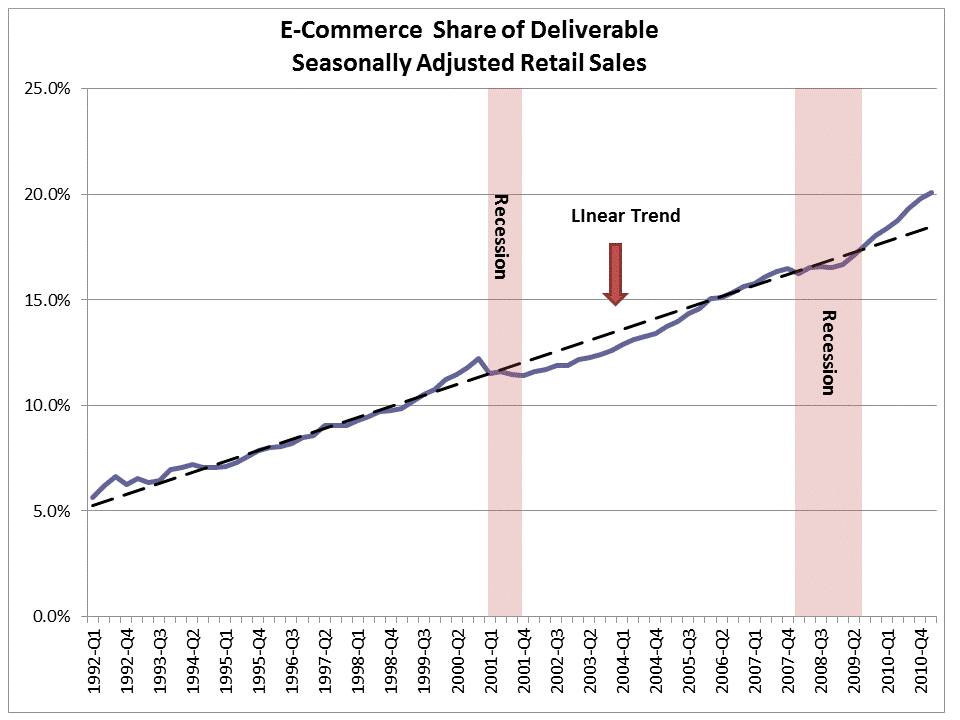
The chart above also illustrates, that for most of the period since 1992, delivered retail sales grew as a share of deliverable retail sales has grown by around 50% about every 7 years ( i.e. 6.67% to 10%, 10% to 15%). Since 2005 the rate of growth in delivered market share has quickened and the fifty percent growth rate to a 22.5% market share should come sometime near the end of next year.
The shift of retail from brick-and-mortar to catalog and e-commerce sales will have a profound impact on the retail supply chain, local economies and demand for print communications.
The retail supply chain over the next decade will have little choice but focus on home delivery. Lower-cost deliveries by parcel carriers and other firms to retail outlets will decline while higher-cost deliveries to homes will increase. The need for pick-up locations for high value items will grow which will increase the market for delivery lockers like those used by Deutsche Post, Post Danmark and DHL.
The growth of e-commerce sales will also increase both shorter-haul deliveries from warehouses within carrier one-day, and to a lesser extent two-day delivery windows. The growth of short haul traffic will also allow regional carriers to continue to grow their market share in more densely populated regional markets.
Finally e-commerce sales provide opportunities for integrated carriers like FedEx and UPS. These carriers can manage home deliveryof high-demand, and high-value items that companies like Apple Computer ship direct from warehouses near the manufacturers in China and other countries in the Pacific Rim.
The impact of delivered retail sales on many local economics is significantly negative. Many communities have a retail infrastructure that reflects a world where less than ten percent of all sales were delivered. Shopping malls and strip centers with vacant store fronts will find it more difficult to rent vacant space and will look to non-traditional and more than likely lower paying tenants like government agencies, libraries, medical and dental offices, and service providers like nail salons. Fewer retail stores mean not just fewer retail jobs but also fewer jobs required to build and maintain retail outlets. Lower brick-and-mortar retail sales will have the effect of lowering gasoline consumption as trips to the store are replaced by trips to the computer. To the extent that restaurant and fast food sales are tied to retail shopping, those sales will slip as well.
The shift of retail sales will have some positive impact on communities located near ideal distribution points that can take advantage of one-day delivery standards of ground parcel delivery. These communities should see growth in jobs in warehousing and transportation and may see some growth in other industries that will piggy-back on strengthened transportation infrastructure that e-commerce distribution supports.
Finally, the shift to on-line sales could have a devastating impact on print advertising, and in particular newspaper display ads and direct mail from local merchants. To the extent that on-line sales cause brick and mortar retailers to go bankrupt, the trend removes print advertisers from the marketplace. Remaining retailers may not be willing to pay as much for advertising as the firms they replace. Adding to the challenge facing print advertising is that the largest on-line retailer, Amazon.com, spends minimally on print advertising and its smaller on-line competitors are no different. Printers and the Postal Service need to find a way to create products that fit the needs of on-line retailers who have found that they could grow their business successfully with minimal print advertising if advertising mail and other forms of print advertising can continue to grow.
Tuesday, March 29, 2011
Logistics Does Not End At The Dock
Here is a video from Great Britain showing the logistics inside of National Health Service Hospital. Obviously internal logistics, including inventory management create real opportunities for companies like DHL, FedEx, TNT and United Parcel Service that handle logistics to the dock door. You can see by looking at shirt logos that thos is a DHL contract operations. So it is possible for DHL to handle the logistics from manufacturer to patient.
Monday, March 21, 2011
Comparing Benefits to the Private Sector
Most of the comparisons made on health benefits compare what the Postal Service offers to what other Federal Employees receive. There are two parts of this benefit. First there are benefits that exist while a person is working for the Postal Service. The second are benefits that accrued while the person works but are payable when they retire.
A similar comparison needs to be made on retirement benefits. While up until the signing of the APWU contract the retirement benefit structure of Postal Service and other federal government employees is the same, it is not clear if the hourly cost per employee is the same as the mix of employees in CSRS and FERS may differ and the contribution rates of Postal Service and Federal Government employees into retirement programs with an employer match may also differ
Postal employees like UPS's teamster employees have both pre- and post-retirement health benefits. FedEx employees only have health benefits while they are working for FedEx.
United Parcel Service has a defined benefit pension plan for most of its Teamster employees. (Those teamsters who participate in the Western States Teamster Pension plan have a hybrid between a defined contribution and defined benefit pension plan.) FedEx offers a retirement plan that includes a defined contribution pension and a 401-K plan which had recently seen its corporate match restored. The Postal Service retains its defined benefit pension for employees hired before 1975 and has a plan similar to what FedEx offers for employees hired since then. The new APWU creates a new retirement plan for non-career employees which is a 401-K plan without an employer match.
As I noted in the post displaying the information from the Teamster Union comparing FedEx and UPS wages and compensation, no comparison has been made comparing these wages and benefits to what the Postal Service offers recently.
One of the biggest complaints about Postal compensation being too high relates to the fact that its share of the health insurance costs is higher than what other Federal agencies pay. The estimate of FedEx costs for health and pension costs of $3.33 gives a benchmark that can be used to compare costs that the Postal Service offers to employees hired since1975 1984. (Given that this is 36 27 years ago it must include most current employees.) (Correction made 1/21/2011 12:40 p.m.)
Under the current APWU contract the Postal Service pays 81% of the total insurance cost. With the figures supplied in the APWU PowerPoint, this works out to $517.80 per month average. If one assumes that an APWU member is employed for 2080 hours in a year then the hourly cost of his health insurance is $2.99. If this was reduced to the 72% of the insurance premium paid for federal workers, the hourly cost of health insurance would drop $0.33 per hour to $2.66. The APWU contract reduces the hourly cost to $2.80 or $0.19 per hour by the end of the contract. (This assumes no health inflation, so it is possible that the cost per hour at the end of the contract will be higher even if the Postal Service's share is lower.)
The difference of a few pennies is small but significant. Reducing health insurance costs by a cent per hour saves the Postal Service $12 million corporate wide annually. The impact of a similar cut for just APWU members is likely around $4 million annually.
What this exercise shows though is that while cutting the Postal Service's share of its health care insurance contribution will reduce costs, discussing this issue may have more merit in scoring political points than solving the severe financial problems of the Postal Service. Even an immediate shift to federal employee levels of insurance contribution would not be enough to get compensation levels down to the point that the Postal Service can be self-sustaining. It is time for those who focus on this issue to look at additional options, including many contained in the APWU contract to do the job.
A similar comparison needs to be made on retirement benefits. While up until the signing of the APWU contract the retirement benefit structure of Postal Service and other federal government employees is the same, it is not clear if the hourly cost per employee is the same as the mix of employees in CSRS and FERS may differ and the contribution rates of Postal Service and Federal Government employees into retirement programs with an employer match may also differ
Postal employees like UPS's teamster employees have both pre- and post-retirement health benefits. FedEx employees only have health benefits while they are working for FedEx.
United Parcel Service has a defined benefit pension plan for most of its Teamster employees. (Those teamsters who participate in the Western States Teamster Pension plan have a hybrid between a defined contribution and defined benefit pension plan.) FedEx offers a retirement plan that includes a defined contribution pension and a 401-K plan which had recently seen its corporate match restored. The Postal Service retains its defined benefit pension for employees hired before 1975 and has a plan similar to what FedEx offers for employees hired since then. The new APWU creates a new retirement plan for non-career employees which is a 401-K plan without an employer match.
As I noted in the post displaying the information from the Teamster Union comparing FedEx and UPS wages and compensation, no comparison has been made comparing these wages and benefits to what the Postal Service offers recently.
One of the biggest complaints about Postal compensation being too high relates to the fact that its share of the health insurance costs is higher than what other Federal agencies pay. The estimate of FedEx costs for health and pension costs of $3.33 gives a benchmark that can be used to compare costs that the Postal Service offers to employees hired since
Under the current APWU contract the Postal Service pays 81% of the total insurance cost. With the figures supplied in the APWU PowerPoint, this works out to $517.80 per month average. If one assumes that an APWU member is employed for 2080 hours in a year then the hourly cost of his health insurance is $2.99. If this was reduced to the 72% of the insurance premium paid for federal workers, the hourly cost of health insurance would drop $0.33 per hour to $2.66. The APWU contract reduces the hourly cost to $2.80 or $0.19 per hour by the end of the contract. (This assumes no health inflation, so it is possible that the cost per hour at the end of the contract will be higher even if the Postal Service's share is lower.)
The difference of a few pennies is small but significant. Reducing health insurance costs by a cent per hour saves the Postal Service $12 million corporate wide annually. The impact of a similar cut for just APWU members is likely around $4 million annually.
What this exercise shows though is that while cutting the Postal Service's share of its health care insurance contribution will reduce costs, discussing this issue may have more merit in scoring political points than solving the severe financial problems of the Postal Service. Even an immediate shift to federal employee levels of insurance contribution would not be enough to get compensation levels down to the point that the Postal Service can be self-sustaining. It is time for those who focus on this issue to look at additional options, including many contained in the APWU contract to do the job.
Saturday, January 1, 2011
Monday, September 20, 2010
Could FedEx be Beating USPS and UPS in Expanding the use of its Retail Network?
In a story today, the Wall Street Journal reported that Walmart is introducing a program that allows customers to buy online and pick up the item at FedEx Office locations as well as Walmart stores. Walmart added this delivery option this summer in Los Angeles and Boston, where FedEx has 24 and 18 FedEx Office locations respectively. In both cities, Walmart has few stores where customers can collect items shipped to a store.

This program allows Walmart to sell its products more effectively to customers who are rarely at home during the day. Also FedEx Office delivery significantly reduces the cost of delivery of large and heavy items making Walmart's site-to-store via FedEx Office a major advantage for online sales.
Randy Scarborough, vice president of marketing for FedEx Office comments to the Wall Street Journal clearly indicates that FedEx Office is looking at parcel pick-up as a significant new revenue stream for its FedEx Office division. He stated that FedEx Office expects "other large retailers to take advantage of this." He further noted that FedEx is planning its "physical network to accommodate this because we do anticipate additional demand."
The current experiment most likely is focusing on:
- removing the logistical kinks in the process both within the FedEx distribution networks and within the FedEx Office retail locations,
- help FedEx determine the revenue that a FedEx Office location will receive for acting as a parcel delivery location and
- help Walmart identify the customers and products that are most likely shipped to a FedEx Office location and which ones still require home delivery.
Friday, September 17, 2010
FedEx Earnings - Implications for the USPS
FedEx's earnings announcement and conference provided some insights into the parcel market and the increasing integration of the Postal Services delivery network with the marketing and distribution capabilities of FedEx. The comments relating to FedEx Smart Post seem to indicate that United Parcel Service and other carriers that compete in the market for delivering small parcels to households, whether by their own drivers or by the Postal Service may be losing market share to FedEx.
Here are the relevant excerpts:
Parcel Volume
Dave Bronczek – President and CEO of FedEx Express from the Q & A
The Postal Service can expect an increase in parcels in the 4th quarter and beyond at least as much as large as what FedEx expects. As will be shown below, the volume of parcels that the Postal Service delivers is tied to how many parcels FedEx and other similar firms feed to its delivery network.
Distribution Patterns
Alan Graf - CFO from the Q and A
In response to a question about inventory, Alan Graf highlights one of the challenges competing in the domestic home-delivery parcel market. Inventory of items manufactured overseas, and in particular items that weigh less than ten pounds are no longer shipped to a domestic warehouse for shipping to the household customers. As the retailer does not know where in the United States the sales will come from or for that matter, what color, size, and in the case of computers, the processor, specific amount of memory, size of hard drive, and other components that the customer plans to order, keeping inventory in the United States becomes quite expensive. Given the difference in labor costs, it becomes cheaper to pay international air freight than to ship a basic model to the United States, and then modify it for individual orders.
FedEx continues to deliver these items within its Express network and United Parcel Service delivers them within their standard network. The Postal Service could enter the market for the delivery of foreign sourced retail sales for home delivery only if it offered a price competitive delivery service in conjunction with DHL or TNT or a foreign post that offered the same security as what FedEx and UPS offer (signature requirements and tracking service) at a competitive price for the total end to end transportation charge. It could more easily offer a price competitive service that allowed for pick-up at a Post Office or automated kiosk in conjunction with any carrier for a price well below the cost of home delivery.
Parcel Prices:
Mike Glen - President and CEO of FedEx Services from the Q & A
We were pleased with the Domestic Express volume performance. It is also being driven by the high-tech high value added sector. But the particular point that I want to make here is about the strong yield management activities that are in place and we will continue going forward. That is our primary objective. While we want to continue to grow volume and expect that we will do that, our primary focus is on improving yields, at the domestic Express business as well as in Ground and certainly LTL. So, our primary focus is not on market share so much as opposed to continuing to improve yields.
Dave Bronczek – President and CEO of FedEx Express from the Q & A
FeEx's increases in yield (average revenue per piece) reflect a concerted effort to raise the average rate that its customers pay. While some of the increase in reflects an increase in weight and a higher proportion of international shipments for FedEx Express, it is clear that even in an economy with slow growth, FedEx is able to raise its prices for parcel delivery services.
Service Quality:
Fred Smith from opening statement
For the Postal Service, FedEx Ground's improved service standards pose a competitive threat to Priority Mail as for many origin destination pairs FedEx Ground rates are less than Priority Mail. To the extent that United Parcel Service is also expanding the geographic area that has delivery in less than two or three days, they create a competitive advantage over Priority Mail.
Integration with the Postal Service Delivery Network:
Mike Glenn - President and CEO of FedEx Services
Fred Smith from the Q & A
Alan Graf - CFO from the opening statement
FedEx clearly sees its SmartPost service as a competitive advantage. Given that it offers shippers in a highly price sensitive market very low parcel delivery rates a competitive service it increases what the Postal Service delivers. Pricing this service to FedEx requires a great deal of understanding as to what FedEx is charging customers and what portion of that charge represents the Postal Service's part. Trying to set this rate within a regulatory context is particularly difficult and raises a question as to whether the rate increases for the Postal Service's portion of the revenue from a parcel delivery shipment should reflect the ability of FedEx and similar carriers to raise prices for end to end service or some other standard.
To the extent that regulated parcel services are primarily originated by FedEx and similar firms, then the value of the regulation to the shipper of regulated rates may be diminished by the benefits that FedEx and similar firms capture for themselves.
Here are the relevant excerpts:
Parcel Volume
Dave Bronczek – President and CEO of FedEx Express from the Q & A
Well, Art, as Fred mentioned in his opening remarks, we expect a very solid peak season. It always gets a little cloudy after that with the key focal point being Chinese New Year. So, we're optimistic about going into the holiday period and I think we'll have strong performance both in our U.S. networks and international networks through the peak season, but it always gets a little cloudy after that with the important period being around Chinese New Year.
We do expect solid industrial production numbers for the calendar year 2010 and going into 2011 in the 4% to 5% range, and we expect a little bit of consumer spending pickup. Our numbers are around 1.5 in calendar year '10 and about 2.6 in calendar year '11. So those are numbers that we’re very comfortable with in terms of supporting our business levels. Obviously, we'll need to wait a little while after peak season to see what the remainder of the year looks like.
The Postal Service can expect an increase in parcels in the 4th quarter and beyond at least as much as large as what FedEx expects. As will be shown below, the volume of parcels that the Postal Service delivers is tied to how many parcels FedEx and other similar firms feed to its delivery network.
Distribution Patterns
Alan Graf - CFO from the Q and A
Let me just add, particularly in the high-tech sector, our customers don't have any inventory. And what's happening, the market is coming to us as there's a disintermediation of intermediate distribution. Items are going directly from where they are manufactured to point of consumption, which is called International Priority Express, and that's what’s so exciting about the next few years around here is, that's going to continue, and with the reliability that we put up, there's no need to have an intermediate warehouse and there's no need to have a backlog of things that can go obsolete on the shelves and that's part of the excitement that we see around here.
In response to a question about inventory, Alan Graf highlights one of the challenges competing in the domestic home-delivery parcel market. Inventory of items manufactured overseas, and in particular items that weigh less than ten pounds are no longer shipped to a domestic warehouse for shipping to the household customers. As the retailer does not know where in the United States the sales will come from or for that matter, what color, size, and in the case of computers, the processor, specific amount of memory, size of hard drive, and other components that the customer plans to order, keeping inventory in the United States becomes quite expensive. Given the difference in labor costs, it becomes cheaper to pay international air freight than to ship a basic model to the United States, and then modify it for individual orders.
FedEx continues to deliver these items within its Express network and United Parcel Service delivers them within their standard network. The Postal Service could enter the market for the delivery of foreign sourced retail sales for home delivery only if it offered a price competitive delivery service in conjunction with DHL or TNT or a foreign post that offered the same security as what FedEx and UPS offer (signature requirements and tracking service) at a competitive price for the total end to end transportation charge. It could more easily offer a price competitive service that allowed for pick-up at a Post Office or automated kiosk in conjunction with any carrier for a price well below the cost of home delivery.
Parcel Prices:
Mike Glen - President and CEO of FedEx Services from the Q & A
We were pleased with the Domestic Express volume performance. It is also being driven by the high-tech high value added sector. But the particular point that I want to make here is about the strong yield management activities that are in place and we will continue going forward. That is our primary objective. While we want to continue to grow volume and expect that we will do that, our primary focus is on improving yields, at the domestic Express business as well as in Ground and certainly LTL. So, our primary focus is not on market share so much as opposed to continuing to improve yields.
Dave Bronczek – President and CEO of FedEx Express from the Q & A
This is Dave. I’ll just add to what Mike said, and I've mentioned this a couple of times before and we'll talk about it in a couple of weeks here. Yes, the volume is up 3% and yes, my yields are up 7% for an overall revenue increase of 10%, but again, the global network that FedEx Express is, the more international packages that end up in the United States in the inbound, or outbound part of my cycle drives more and more profits automatically. So, the more international packages that end up in my U.S. domestic trucks coupled with the yield improvement program that Mike just talked about is a significant profit driver for FedEx Express.
FeEx's increases in yield (average revenue per piece) reflect a concerted effort to raise the average rate that its customers pay. While some of the increase in reflects an increase in weight and a higher proportion of international shipments for FedEx Express, it is clear that even in an economy with slow growth, FedEx is able to raise its prices for parcel delivery services.
Service Quality:
Fred Smith from opening statement
FedEx Ground continues to accelerate its network providing a clear speed advantage over the competition. Quite simply, FedEx Ground is faster to more U.S. locations than any other ground carrier.
Just since this last January, FedEx Ground has increased the speed of nearly 3,700 lanes. Since June 2003, FedEx Ground has accelerated its delivery times by one day or more in about 82,000 lanes. FedEx Ground now delivers more than half its volume of packages in two business days or less, and more than 80% in three days or less. FedEx Ground service levels are at all-time highs.
For the Postal Service, FedEx Ground's improved service standards pose a competitive threat to Priority Mail as for many origin destination pairs FedEx Ground rates are less than Priority Mail. To the extent that United Parcel Service is also expanding the geographic area that has delivery in less than two or three days, they create a competitive advantage over Priority Mail.
Integration with the Postal Service Delivery Network:
Mike Glenn - President and CEO of FedEx Services
I want to comment on one thing and caution you about looking at the Ground numbers in a vacuum. One of the strategic advantages that we have is SmartPost. SmartPost allows us to attack the residential lightweight business in a very efficient and profitable way. So rather than trying to steer that traffic into the Ground network and the Home network in particular, we steer that traffic into the SmartPost network.
So by definition, some of the growth potential that might otherwise go to Ground is going to SmartPost, and I think you can see the very strong performance we have there. So you have to look at our Ground strategy as an overall residential strategy, including SmartPost. We are very pleased with our ability to continue to have industry-leading growth rates and very strong yield improvement efforts at Ground, and I think that's based upon the combination of a great sales team that is armed with the tremendous value proposition and that's a formula for success.
Fred Smith from the Q & A
So, a good example of that is what Mike Glenn just talked to you about. If you really want to talk about the most cost-sensitive segment of the market, it is lightweight, low value-added retail items going to the home. There is no one that has the density that can compete with United States Postal Service. That's why several years ago, we came up with the strategy of developing a SmartPost service, and why it is growing at huge rates. So, we firmly believe that our strategy which has allowed us to pick-up in the commercial ground sector, what about 12 market share points...
Alan Graf - CFO from the opening statement
FedEx SmartPost average daily volumes grew 9% to $1.1 million as a result of gains in market share and the introduction of new service offerings. Yields at FedEx SmartPost increased 19% primarily due to lower postage costs as a result of increased deliveries to U.S. Postal Service, final destination facilities and higher fuel surcharges.
FedEx clearly sees its SmartPost service as a competitive advantage. Given that it offers shippers in a highly price sensitive market very low parcel delivery rates a competitive service it increases what the Postal Service delivers. Pricing this service to FedEx requires a great deal of understanding as to what FedEx is charging customers and what portion of that charge represents the Postal Service's part. Trying to set this rate within a regulatory context is particularly difficult and raises a question as to whether the rate increases for the Postal Service's portion of the revenue from a parcel delivery shipment should reflect the ability of FedEx and similar carriers to raise prices for end to end service or some other standard.
To the extent that regulated parcel services are primarily originated by FedEx and similar firms, then the value of the regulation to the shipper of regulated rates may be diminished by the benefits that FedEx and similar firms capture for themselves.
Friday, July 2, 2010
Could the Postal Service Lose its Niche in Parcel Delivery?
The Postal Service's parcel delivery business have a limited competitive advantage in serving customers that send three types of shipments.
Unfortunately for the Postal Service these advantages are tenuous. Postal Service competitors are now exploring secure alternative delivery options for households that reduce delivery costs per package by eliminating delivery to the home itself and more importantly eliminating multiple delivery attempts when no one is home when the first attempt is made. These carriers are exploring the marketing campaign needed to implement the parcel pick-up and delivery systems sold by KEBA and now installed by Austrian Post, DHL Deutsche Post, Post Danmark, Posten Norge, and PTT Turkey.
If such a system is installed in the United States, the Carrier could provide the recipient with the location of the secure parcel box and the code for retrieving their parcel as part of the track and trace record. Such boxes could be placed outside of existing retail outlets like FedEx Office, Staples, UPS Stores or other contracted location offering 24-hour access to delivered parcels. Without the need for employees to staff a parcel location, private sector carriers could offer full service parcel and express services in communities that are currently too small for even franchise or contract locations. Such a system would also allow private sector carriers to offer six and even seven day delivery without requiring it to go to every address that receives a parcel. This would be a major advantage if the Postal Service eliminates its Saturday delivery service.
This blog discussed how such a system could expand the retail presence of the Postal Service last August through the use of such automated parcel systems. in two posts.
Should the Postal Service Close All Post Offices?
Marketing the Pakstation
If competitors chose to do this first, then the Postal Service risks the loss of a significant share of its parcel delivery business that exist because competitors chose it as the delivery contractor. The Postal Service could further lose business from retail customers who find that the automated solutions of competitors are more convenient.
- Items under 2 or 3 pounds shipped to households. These customers either ship these items themselves or use a consolidator like FedEx Smart Post.
- Items shipped to rural areas and in particular rural households.
- Infrequent shippers who find retail services offered by the Postal Service more convenient or lower in cost.
Unfortunately for the Postal Service these advantages are tenuous. Postal Service competitors are now exploring secure alternative delivery options for households that reduce delivery costs per package by eliminating delivery to the home itself and more importantly eliminating multiple delivery attempts when no one is home when the first attempt is made. These carriers are exploring the marketing campaign needed to implement the parcel pick-up and delivery systems sold by KEBA and now installed by Austrian Post, DHL Deutsche Post, Post Danmark, Posten Norge, and PTT Turkey.
If such a system is installed in the United States, the Carrier could provide the recipient with the location of the secure parcel box and the code for retrieving their parcel as part of the track and trace record. Such boxes could be placed outside of existing retail outlets like FedEx Office, Staples, UPS Stores or other contracted location offering 24-hour access to delivered parcels. Without the need for employees to staff a parcel location, private sector carriers could offer full service parcel and express services in communities that are currently too small for even franchise or contract locations. Such a system would also allow private sector carriers to offer six and even seven day delivery without requiring it to go to every address that receives a parcel. This would be a major advantage if the Postal Service eliminates its Saturday delivery service.
This blog discussed how such a system could expand the retail presence of the Postal Service last August through the use of such automated parcel systems. in two posts.
Should the Postal Service Close All Post Offices?
Marketing the Pakstation
If competitors chose to do this first, then the Postal Service risks the loss of a significant share of its parcel delivery business that exist because competitors chose it as the delivery contractor. The Postal Service could further lose business from retail customers who find that the automated solutions of competitors are more convenient.
Thursday, June 17, 2010
How Smart Post Makes FedEx More Profitable
In the conference call with analysts this week, Mike Glenn, President and CEO of FedEx Services, explained how Smart Post makes FedEx more profitable.
One of the key advantages that we have in our ability to not only deliver solid growth rates, but yield improvement at the same time is the ability to balance our ground and home services with SmartPost.
Customers that are benefiting from e-commerce and e-tailing in general tend to be growing at higher rates. At the same time, many of those companies produce packages that result in lower yields for us. While we’re prepared to handle that traffic, we’re going to ship that traffic where appropriate into the SmartPost network and allow us to balance our growth in the respective networks, and ensure that we get an appropriate yield per package for each one of those transactions. So we really have a good portfolio of services that is ideal to take advantage of the market trends and the growth out there yet at the same time deliver yield improvements.
FedEx SmartPost volume grew 23% in the quarter which is far faster than any Postal Service shipping or package service. This growth confirms that FedEx is more than likely the largest supplier of parcels for delivery to the Postal Service and is taking market share from shippers that used to deal with the Postal Service directly as well as those that used parcel consolidation services offered by United Parcel Service and other providers.
As noted earlier, SmartPost is used to handle light weight shipments for home delivery. SmartPost as well as FedEx Ground and FedEx Home fit well as the last leg in the current supply chains that involve manufacturing overseas, sales via the internet, and delivery to a home and office.
Tuesday, April 13, 2010
Postal Policy: Now its Congress's Turn
Now that the Government Accountability Office report is out it is time for Congress to get down to the serious business of re-evaluating the current business model and regulatory framework. Congress is starting this process with hearings in the House and Senate, this week and next. In preparing for these hearing, members on the relevant committees have a significant challenge preparing for the postal and other governmental witnesses.
Both hearings will focus on reports by the Postal Service, Government Accountability Office and the USPS Office of Inspector General.
The three reports by the USPS Office of Inspector General cover technical actuarial and accounting issues over which there is a dispute between the Postal Service and the Office of Personnel Management as well as a critique of Congressional budgetary actions relating to the Postal Service. The CRS, GAO and the Postal Service have recognized the importance of the resolving the CSRS accounting and retiree health care funding issues in their reports. The critique of Congressional budgetary actions provides some context as to how Congress and the Office of Management and Budget has historically viewed their responsibility for the Postal Service and how the Postal Service’s cycles of strong and weak financial performance can be used as part of the solution of meeting budget goals.
The Postal Service’s report provides an action plan for operating its business within the current business enterprise business model. The modifications requested are changes from current financial, operating, employment, and marketing efforts that Postal Service management and the Board of Governors are sufficient to return the Postal Service to financial stability.The Postal Service’s report does not address the overarching mail industry policy, corporate governance and regulatory framework issues in any detail. Nor does the Postal Service report provide a vision for the Postal Service’s role in the US economy in 2020 that is much different than what now exists with the exception that its impact will be much smaller.
The GAO’s report, like the one produced by the Postal Service, provides strategies necessary to improve Postal Service operating, and to a lesser extent revenue management, and highlights Congressional action necessary to allow those improvements to occur. The GAO report goes beyond previous reports in its examination of the Postal Service’s cost structure and the legal impediments that prevent it from adjusting its costs to match current and projected revenue. The GAO report, like the Postal Service report does not address in detail the mail industry policy, corporate governance and regulatory framework issues that affect the Postal Service’s ability to implement operating, and marketing plans to best meet the needs of mailers and parcel shippers.Neither does the GAO report provide Congress with information that would help it understand the role that the mailing industry, and the Postal Service as the core of that industry could have in the US economy in 2020 and beyond.
The Congressional Research Service (CRS)report focuses on a “number of ideas for incremental reforms have been put forth that would improve the USPS’s financial condition in the short term so that it might continue as a self-funding government agency, all of which would require Congress to amend current postal law.” The ideas that the CRS reviews are those previously presented by the Postal Service and the USPS OIG and include many included in the GAO report as well. The CRS notes the objections of the Office of Personnel Management to the changes in retiree benefit obligation calculation or funding schedules. CRS’s description of the report’s focus nicely summarizes the overall tenor of all of the reports that Congress will review in upcoming hearings.
Before developing their approach to questioning the witnesses, members of Congress have to first understand what the reports that the witnesses are presenting to them are and what they are not. The reports that Congress has before it present:
The following set of questions represent examples of the types of questions that Congress needs to ask witnesses in order to develop the framework within which incremental reforms make sense. While some of the government entities can answer these questions, many of them go beyond the scope of the studies that they have just completed or their role in developing postal industry policy.
It may be time for Congress to begin the process of framing these questions so that GAO, CRS, the USPS OIG, the USPS or entities in the executive branch responsible for economic development, communications and transportation policy answer them. After they are answered, Congress will be able to move forward on the incremental steps that the various reports suggest with an understanding of the broader policy context within the individual steps fit.
General Postal Industry Policy
Postal Governance
Both hearings will focus on reports by the Postal Service, Government Accountability Office and the USPS Office of Inspector General.
- Federal Budget Treatment of the Postal Service by the USPS OIG
- The Postal Service’s Share of CSRS Pension Responsibility by the USPS OIG
- Final Management Advisory Report – Estimates of Postal Service Liability for Retiree Health Care Benefits by the USPS OIG
- Ensuring a Viable Postal Service for the Postal Service: An Action Plan for the Future by the U.S. Postal Service
- U.S. Postal Service: Strategies and Options to Facilitate Progress toward Financial Viability by the Government Accountability Office
- The U.S. Postal Service’s Financial Condition: Overview and Issues for Congress by the Congressional Research Service
The three reports by the USPS Office of Inspector General cover technical actuarial and accounting issues over which there is a dispute between the Postal Service and the Office of Personnel Management as well as a critique of Congressional budgetary actions relating to the Postal Service. The CRS, GAO and the Postal Service have recognized the importance of the resolving the CSRS accounting and retiree health care funding issues in their reports. The critique of Congressional budgetary actions provides some context as to how Congress and the Office of Management and Budget has historically viewed their responsibility for the Postal Service and how the Postal Service’s cycles of strong and weak financial performance can be used as part of the solution of meeting budget goals.
The Postal Service’s report provides an action plan for operating its business within the current business enterprise business model. The modifications requested are changes from current financial, operating, employment, and marketing efforts that Postal Service management and the Board of Governors are sufficient to return the Postal Service to financial stability.The Postal Service’s report does not address the overarching mail industry policy, corporate governance and regulatory framework issues in any detail. Nor does the Postal Service report provide a vision for the Postal Service’s role in the US economy in 2020 that is much different than what now exists with the exception that its impact will be much smaller.
The GAO’s report, like the one produced by the Postal Service, provides strategies necessary to improve Postal Service operating, and to a lesser extent revenue management, and highlights Congressional action necessary to allow those improvements to occur. The GAO report goes beyond previous reports in its examination of the Postal Service’s cost structure and the legal impediments that prevent it from adjusting its costs to match current and projected revenue. The GAO report, like the Postal Service report does not address in detail the mail industry policy, corporate governance and regulatory framework issues that affect the Postal Service’s ability to implement operating, and marketing plans to best meet the needs of mailers and parcel shippers.Neither does the GAO report provide Congress with information that would help it understand the role that the mailing industry, and the Postal Service as the core of that industry could have in the US economy in 2020 and beyond.
The Congressional Research Service (CRS)report focuses on a “number of ideas for incremental reforms have been put forth that would improve the USPS’s financial condition in the short term so that it might continue as a self-funding government agency, all of which would require Congress to amend current postal law.” The ideas that the CRS reviews are those previously presented by the Postal Service and the USPS OIG and include many included in the GAO report as well. The CRS notes the objections of the Office of Personnel Management to the changes in retiree benefit obligation calculation or funding schedules. CRS’s description of the report’s focus nicely summarizes the overall tenor of all of the reports that Congress will review in upcoming hearings.
Before developing their approach to questioning the witnesses, members of Congress have to first understand what the reports that the witnesses are presenting to them are and what they are not. The reports that Congress has before it present:
- Incremental reforms that proponents suggest would improve the Postal Service’s financial condition in the short term; and
- Incremental reforms that retain the current model of the Postal Service as a self-funding government agency
The following set of questions represent examples of the types of questions that Congress needs to ask witnesses in order to develop the framework within which incremental reforms make sense. While some of the government entities can answer these questions, many of them go beyond the scope of the studies that they have just completed or their role in developing postal industry policy.
It may be time for Congress to begin the process of framing these questions so that GAO, CRS, the USPS OIG, the USPS or entities in the executive branch responsible for economic development, communications and transportation policy answer them. After they are answered, Congress will be able to move forward on the incremental steps that the various reports suggest with an understanding of the broader policy context within the individual steps fit.
General Postal Industry Policy
- What should the overall objective of postal industry policy over the next decade and beyond and where does the Postal Service fit into that objective?
- Is that objective different from the objective of either the Postal Reorganization Act or the Postal Accountability and Enhancement Act both written when digital competition was less pervasive?
- Is a self funding government enterprise, the best way to employ the postal market to generate economic growth and jobs in the United States or do other models provide greater opportunities to grow the US economy?
- What impact do restrictions on entry of private sector entry into mail delivery and the Postal Service into non-postal products have on economic growth and jobs in the United States?
- What benefits are generated by these restrictions and how do the benefits compare to the impact on economic growth and jobs?
- What impact do current postal pricing law and the Postal Regulatory Commission’s interpretation of that law have on U.S. economic growth and jobs? How would different postal pricing law affect or regulatory policy affect economic growth and jobs?
- How does Postal Rate Commission regulatory responsibility affect economic growth and jobs and how does that compare to the benefits of regulation?
Postal Governance
- Is the USPS, as currently constituted, incapable of responding to a shifting, and possibly declining, market for its products and services?
- Is the USPS as currently constituted handicapped in responding to a shifting and possibly declining, market for its product and services?
- How does the current governance structure as a government sponsored enterprise affect the Postal Service’s ability to manage the types of changes that the GAO, the CRS and the Postal Service describe?
- How does the governance structure affect the speed at which the Postal Service reacts to changes in the postal market?
- Does the current Postal Service board have sufficient experience in managing similar enterprises?
- What would be required to ensure that it does?
- How does the choice of a governance model (i.e. private sector vs. government enterprise) affect the choice of regulatory policy for the industry?
- What is the financial measure that determines whether the Postal Service’s action plan or for that matter any action plan succeeds?
- Is that financial measure sufficient to ensure that the Postal Service is self sufficient?
- What is the financial measure that determines that a government enterprise is self-funding and is that the same measure that would determine if it is self sustaining?
- Does self sustaining require only accounting break even or does it require a positive operating margin and rate of return?
- What is the fundamental role in the US Postal Service in the US communications and goods distribution infrastructure today?
- By 2020, what proportion of mail will contain advertising whether in the form of direct mail, inserts in bills and statements or periodicals? How much greater is that from today?
- How will the increased importance in revenue from advertising change the fundamental role of the Postal Service?
- What impact does digital delivery of transaction documents, advertising, and personal communications have on the value of the Postal Service monopoly?
- How should that impact be measured?
- How does the existence of digital alternatives affect the price competitiveness of mail?
- In particular, which industries using mail to distribute periodicals, send documents and correspondence, handle business transactions or advertise of customers are most sensitive to competition from electronic alternatives?
- How does the proposal to eliminate a day of delivery affect individual vertical mail markets (i.e. personal correspondence, weekly newspapers, real estate advertising, supermarket advertising, utility bills and payments, etc.)?
- How do Postal Service wages and benefits compare with those offered by private sector firms in the postal industry such as FedEx, United Parcel Service, and Pitney Bowes?
- What was the difference in the retirement rate of early retirement offers using voluntary early retirement authority and the incentives granted last fall?
- How many months prior to normally planned retirement date do those that retire with an incentive retire and how much does that save the Postal Service?
- What is the difference in net present value cost of offering an early retirement incentive to an employee as compared to retaining an employee whose position is excessed and paying them a salary above what their new position normally calls for?
- How does attrition rate affect the decision to reduce network capacity?
- (For the GAO) How long have you presented recommendations that the Postal Service take effort to reduce its operating network?
- What are the impediments in the Postal Service’s governance structure, labor agreements, cash flow, or culture that has prevented it from acting on network realignment faster?
- How do attrition rates affect the decision to restructure the network?
- How would the restructuring differ if the proportion of part-time employees increased?
- How would the speed of the processing network optimization change if retirement incentives were readily available to handle the reduction in the need for employees?
- What would be the upfront cost of using retirement incentives as part of a network restructuring?
- What should the overall objectives of a postal network / retail network realignment commission be set?
- Should a postal network / retail network realignment commission have the authority to make recommendations in regards to policy, governance, or regulatory impediments to the development of an efficient and effective network of processing and retail facilities?
- What should the metric be for determining retail access to the services the USPS offers?
- What proportion of users of retail customers of households and what proportion of users are non-households?
- How often do households on average use a retail postal outlet? Does it vary by age, geography, or rural area?
- What is the difference in access to retail services today in urban, suburban and rural parts of the United States?
- How does access to USPS retail services compare to access to retail services of UPS and FedEx in urban, suburban and rural parts of the United States?
- How have UPS and FedEx managed with primarily a contract/self-service model and are there differences in their retail customers that could affect the use of that model by the Postal Service?
- What is the experience in other countries with their satisfaction with postal retail services before and after a switch to self-service and contract models?
- Is the issue of money losing products more an issue of cost levels or price levels?
- What impact would only solving the problem with raising price have on the volumes handled and the ability of the Postal Service to meet its policy objectives?
- GAO in its list of highlights for revenue generates suggests that the Postal Service revise pricing for market-dominant products, such as First-class Mail and Standard mail?
- What revisions does the GAO suggest the Postal Service make?
- How does current regulatory precedent and pricing objectives affect the ability to make the changes that GAO would suggest?
- How do pricing objectives in the law and PRC precedent affect the ability of the Postal Service to implement the pricing flexibility that GAO and others suggest?
Subscribe to:
Posts (Atom)

 Posts


