Showing posts with label on-line retailing. Show all posts

Tuesday, July 19, 2011

On-line Sales Share of Retail Sales Hits New High in May

The U.S. Census Bureau retail sales data released last week showed that in May, the share of retail sales that are sold on-line or via a catalog rose to 20.5% of retail sales from merchants selling products that are sold both in brick and mortar stores, on-line or through a catalog. This means that 20.5% of all retail sales that could be delivered by FedEx, United Parcel Service or the United States Postal Service, are being delivered by these firms. (Details on how the proportion is calculated is at the bottom of this post.)
May represents the sixth month in a row that on-line/catalog merchant sales were more than 20% of sales of items that could be delivered to a consumer were delivered to the consumer rather than purchased at a retail store A year ago 18.8% of sales of items that could be delivered to a consumer were delivered. The following chart shows retail sales data dating back to 1992 as provided by the Census Bureau.  
The chart also includes an exponential trend, and for the statistical geeks, the trend equation and R-squared. The trend line illustrates that the shift to on-line retailing has grown exponentially since data was available with deviations occurring only around the two recessions in the period graphed.  The statistical properties of the exponential trend are improved insignificantly from last months trend.

The shift to retail sales from on-line and catalog merchants may partially explain the decisions of Borders, American Eagle, Gap, Lowe's and other brick and mortar retailers to close stores or stop expansion as the total dollar sales at brick and mortar outlets stagnates as on-line and catalog sales grow.

Explanation of Chart Data

The proportion illustrate in the chart represents the proportion of catalog and on-line sales estimated by the Census Bureau as a portion of sales at furniture & home furnishings (442), electronics & appliances (443), clothing & accessories (448), sporting goods, hobby, book, and music (451), general merchandise (452), office supply, stationery, and gift stores (4532) stores as well as on-line and catalog merchants (4541). [The numbers in parentheses are the NAICS codes used by the Census Bureau to classify businesses.]

Sunday, April 24, 2011

The Rise of E-commerce - How does it affect FedEx, USPS, and UPS?

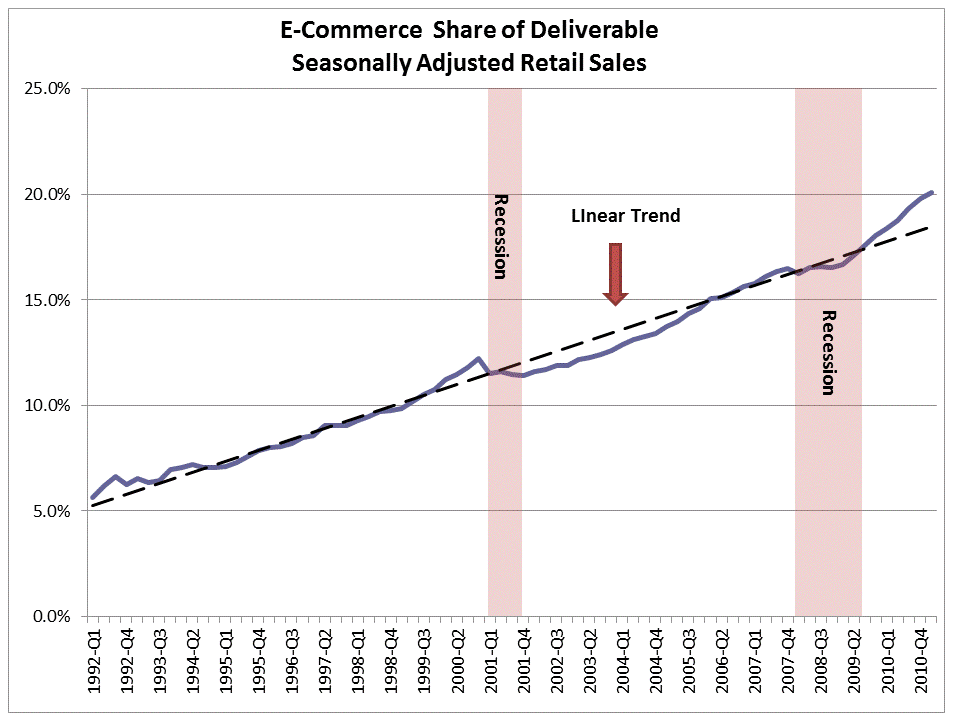
E-commerce in the fourth quarter of 2010 for the first time clearly represented more than 20% of all deliverable retail sales.    E-commerce's share of retail sales grew by a third in less than 5 years. 

The following graph illustrates the change in share of seasonally adjusted retail sales.

The 20% figure represents the proportion of catalog and on-line sales estimated by the Census Bureau as a portion of sales at furniture & home furnishings (442), electronics & appliances (443), clothing & accessories (448), sporting goods, hobby, book, and music (451), general merchandise (452), office supply, stationery, and gift stores (4532) stores as well as on-line and catalog merchants (4541). [The numbers in parentheses are the NAICS codes used by the Census Bureau to classify businesses.]  As many retailers, (i.e., Walmart, JCPenney, Target, Best Buy, Limited Brands (Victoria's Secret, Bath and Body Works) and Best Buy) that currently generate most of their sales from brick and mortar outlets now generate a growing proportion of their total sales from their websites, this proportion represents a conservative estimate of the share of deliverable retail sales that FedEx, United Parcel Service or the United States Postal Service are delivering.

The chart above also illustrates, that for most of the period since 1992, delivered retail sales grew as a share of deliverable retail sales has grown by around 50% about every 7 years ( i.e. 6.67% to 10%, 10% to 15%).  Since 2005 the rate of growth in delivered market share has quickened and the fifty percent growth rate to a 22.5% market share should come sometime near the end of next year.  

The shift of retail from brick-and-mortar to catalog and e-commerce sales will have a profound impact on the retail supply chain, local economies and demand for print communications.

The retail supply chain over the next decade will have little choice but focus on home delivery.   Lower-cost deliveries by parcel carriers and other firms to retail outlets will decline while higher-cost deliveries to homes will increase.   The need for pick-up locations for high value items will grow which will increase the market for delivery lockers like those used by Deutsche Post, Post Danmark and DHL. 

The growth of e-commerce sales will also increase both shorter-haul deliveries from warehouses within carrier one-day, and to a lesser extent two-day delivery windows.   The growth of short haul traffic will also allow regional carriers to continue to grow their market share in more densely populated regional markets.  

Finally e-commerce sales provide opportunities for integrated carriers like FedEx and UPS.  These carriers can manage home deliveryof high-demand, and high-value items that companies like Apple Computer ship direct from warehouses near the manufacturers in China and other countries in the Pacific Rim. 

The impact of delivered retail sales on many local economics is significantly negative.   Many communities have a retail infrastructure that reflects a world where less than ten percent of all sales were delivered.   Shopping malls and strip centers with vacant store fronts will find it more difficult to rent vacant space and will look to non-traditional and more than likely lower paying tenants like government agencies, libraries, medical and dental offices, and service providers like nail salons.  Fewer retail stores mean not just fewer retail jobs but also fewer jobs required to build and maintain retail outlets.   Lower brick-and-mortar retail sales will have the effect of lowering gasoline consumption as trips to the store are replaced by trips to the computer.  To the extent that restaurant and fast food sales are tied to retail shopping, those sales will slip as well.

The shift of retail sales will have some positive impact on communities located near ideal distribution points that can take advantage of one-day delivery standards of ground parcel delivery.   These communities should see growth in jobs in warehousing and transportation and may see some growth in other industries that will piggy-back on strengthened transportation infrastructure that e-commerce distribution supports.

Finally, the shift to on-line sales could have a devastating impact on print advertising, and in particular newspaper display ads and direct mail from local merchants.    To the extent that on-line sales cause brick and mortar retailers to go bankrupt, the trend removes print advertisers from the marketplace.  Remaining retailers may not be willing to pay as much for advertising as the firms they replace.  Adding to the challenge facing print advertising is that the largest on-line retailer, Amazon.com, spends minimally on print advertising and its smaller on-line competitors are no different.    Printers and the Postal Service need to find a way to create products that fit the needs of on-line retailers who have found that they could grow their business successfully with minimal print advertising if advertising mail and other forms of print advertising can continue to grow.  

Saturday, March 5, 2011

The Return of the "Catalog" Retailer

The February employment numbers showed a growing private sector economy in every sector except retail.   Retail jobs dropped by 8,100.     Retail jobs can grow only to the extent that sales at brick and mortar outlets are growing. 

The decline in retail jobs reflects the shift from brick-and-mortar to online retail sales.  In December 2010, online-and catalog merchant sales recorded by the Bureau of the Census grew by 20% over 2009 while retail sales at brick and mortar focused retailed grew by 3.2% in the same period.   In February, 2011, American Banking and Market News reported that online retail sales grew by 13.2%, over three times the 3.8% the growth rate of retail sales in general.

The shift to on-line sales is most clearly evident at America's nationwide department stores including jcPenney's, Macy's, Sears, Target, and Walmart and large specialty retailers like American Apparel, Gap Stores, Best Buy, and Barnes and Noble.   Both Sears and jcPenney's used to be known for their large catalog divisions that no longer print the "big book" catalogs but now sell products for home delivery on-line. Sears and BestBuy allow customers to buy online for nearly immediate pick-up and both jc Penney's and Walmart help customers cut shipping costs through ship-to-store options.   Sears even runs an on-line marketplace that competes with the marketplaces of Amazon.com and eBay.

The growth of the on-line sales of traditional retailers is now significant enough that both jcPenney's and Macy's announced the growth of on-line sales in February at the same time they announced their monthly sales figures.  For jcPenney's  online sales grew by 11.8% which helped the store generate a total same store sales growth of 6.4%   Macy's generated a 30.9% growth in on-line sales which allowed total same-store sale growth to reach 5.8%.   For both stores, their recent results suggest that their on-line "catalogs" will drive their sales growth with brick-and-mortar outlets lagging behind.

For the economy, the shift to on-line retailing means a shift in jobs and economic activity away from brick and mortar retail outlets and businesses that create and support the consumer retail infrastructure to segments of the economy responsible for selling and delivering goods to consumers at home.   Rather than hiring more retail employees, jcPenney's and Macy's are going to have to hire more warehouse employees to pick and pack the items for on-line purchases.    Those jobs will likely be in distribution hubs like those that exist in central Pennsylvania that allow a company to ship to consumer within a day or two of the order and less will be in the communities where the brick and mortar outlets now are.   There will be a ripple effect in this shift in construction and real estate as the consumer retail infrastructure is rightsized and the on-line retail infrastructure grows. 

On-line sales give stores like Macy's and jc Penney's a broader geographic footprint than their retail outlets.   It allows items advertised on the Macy's Thanksgiving Day Parade to be sold in rural Nebraska where the nearest Macy's may be 100's of miles away and the nearest Walmart or Kmart may be well over 25 miles away.

In order for online retailing to grow the way that it has, retailers like Macy's and jcPenney's need a sound and reliable infrastructure for both delivering their products to consumers and means to advertise their on-line catalogs and they need one that reaches not only every household in metropolitan New York City, but one that can reach the most rural towns in the Great Plains or in Appalachia.    This is where the courier, express and postal industry comes in.  This industry, while primarily designed for business-to-business shipments, has adapted to the business-to-consumer market and has done it generally profitably. 

Profitability of parcel delivery requires that rates charged reflect differences in costs by shipment and by customer.   Delivering to households cost more for private sector carriers as many of these deliveries require multiple delivery attempts or involve only delivering a single item, so private sector carriers charge more.  Delivering to locations far from terminals to locations that are less densely populated also cost more as the time it takes to get to the delivery point is greater so charges by private sector carriers generally are higher to those points as well.     Private sector carriers have also expanded their use of the Postal Service for home deliveries of light weight items which reflects the primary business of the Postal Service, household delivery.  The joint private sector-Postal Service delivery service can allow private sector carriers to profitably sell the delivery of light weight parcel delivery services by purchasing Postal Service delivery at rates below their own operating costs.   Both jc Penney's and Macy's rely heavily on Postal Service delivery for items that one of the major private sector carriers pick-up from one of their warehouse.

The Postal Service has increasingly become a core part of the on-line retail delivery network as the on-line sales volume of light-weight, relatively low-value items like apparel and domestic goods have grown.  It must continue to remain a core part of that network for jcPenney's, Macy's and hundreds of other retailers to be able to growth their businesses.   For that to happen, the Postal Service's parcel delivery operation has to be profitable so that it will have the capital to invest in the infrastructure that will be needed to handle volumes that could grow at double-digit rates.   Profitability must apply to all parcel shipments regardless of class or customer and must include customers shipping single parcels.

Profitability also requires greater flexibility in pricing than now exists.   Most of the customers of private sector parcel carriers buy their services using contracts that are define discounts off of list rates based on the annual volume of business a customer does with the carrier.  Contracts exist for customers from those shipping just a few shipments per week to those spendiong tens of millions on parcel shipping. The discounts differ not only based on the total annual volume, but also total volume per shipment, and the distance that a particualr shipper is located from the carrier's distribution hubs.  Depending on the volume, carriers even negotiate significant discounts in rural and home delivery surcharges and may wave pick-up charges all together.  

The Postal Service needs to shift its pricing model to reflect private sector practice and allow it to price its parcels to reflect differences among its parcel-delivery customers as to     The sooner that obstacles to such practice could be eliminated the better for the future of the growth of on-line retailing.